By Martin Sheppard
For most of its existence, the least prepossessing street in Primrose Hill has been Dumpton Place, the dead end off Gloucester Avenue opposite Fitzroy Road. Its name might indeed be thought appropriate for a short cul-de-sac with few obvious attractions: the lure of the entrance to The Lansdowne, at its junction with Gloucester Avenue, offset by the pub’s prominent bins in Dumpton Place itself.
Dumpton Place has, however, recently come to life, due to the initiative of the Primrose Hill Conservation Area Advisory Committee. The number of its parking bays has been greatly reduced and the pavement outside The Lansdowne extended to accommodate an extra row of benches, fully occupied by drinkers in summer. Opposite these, there is a Banksy-esque mural of ‘The Dream Band’, the imaginary all-time greatest pop group. By Loretto, it features Elvis Presley fronting Bob Dylan, Jimi Hendrix, John Lennon and Keith Moon. At the railway end, there is now a small garden with two young silver birches and an alder tree. When these are grown, the view towards the railway from Fitzroy Road will complement that looking towards Primrose Hill.
At one point, until a fire in mysterious circumstances in about 1980, The Lansdowne (a pub dating back to the 1850s) was known for its strippers. Then, after a short spell as a managed pub, it became a gastropub, offering good food and congenial surroundings, without musak, for thirty years. During this time, Dumpton Place was occasionally transformed for the day, being covered in sand and used for boules tournaments. It was also an occasional venue for Morris dancing. One Christmas there was even a reindeer outside the pub. The apogee of The Lansdowne’s reputation was probably reached in September 2012, when Baggage, a play by John Muirhead and Mike Charlesworth, and set mainly in the pub, premiered at the Arts Theatre in the West End. It established an evening’s drinking in The Lansdowne, followed by an excursion to the top of Primrose Hill, as an almost infallible recipe for seduction.
Before Dumpton
Dumpton Place was not the original name. It was Fitzroy Place until 1870. When Charles Fitzroy, third Lord Southampton, auctioned off the freehold of what is now Primrose Hill village in 1840, the auction map laid out the roads intended for the area. Most of these are still in place today, but the line of what was to become Gloucester Avenue ran at the outside edge of the lots being auctioned. The London and Birmingham Railway later bought this original boundary road from the Southampton estate, to make more space to build an engine shed. This resulted in the line of Gloucester Avenue being moved to the west, no longer running at the edge of the auctioned building lots but cutting through them. The change led to the curve at the top of Gloucester Avenue and a break in the eastern section of Fitzroy Road, leaving Fitzroy Place, later to become Dumpton Place, a short and stumpy widow.
It is not clear why the Metropolitan Board of Works, the predecessor to the London County Council, chose the name of Dumpton, which is an uncommon one, to replace Fitzroy Place. No one has Dumpton as a surname, so the involvement of a builder named Dumpton can be ruled out. Although there is a Dumpton Hill, near Honiton in Devon, with an ancient hill fort on top of it, the most probable derivation of the name is from Dumpton Gap, a bay near Broadstairs. With other early seaside resorts such as Herne Bay, Margate and Ramsgate, this would have had a positive resonance for the Victorians.

Railway Crossing
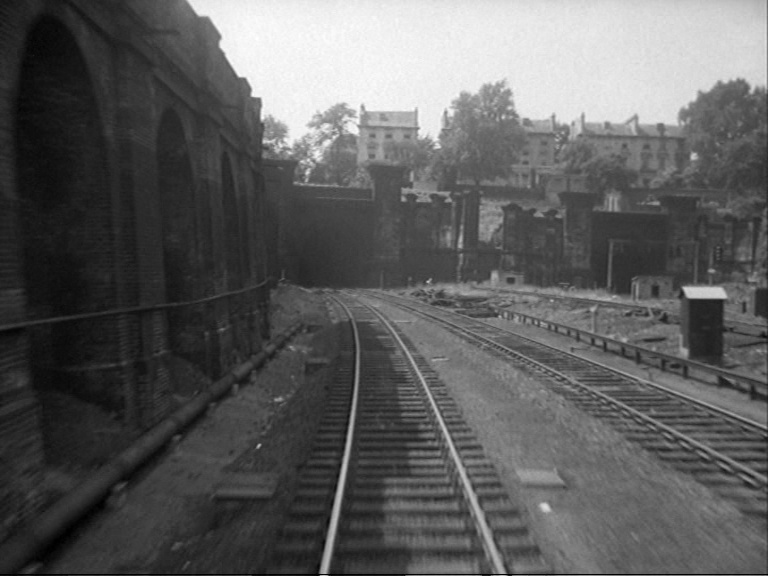
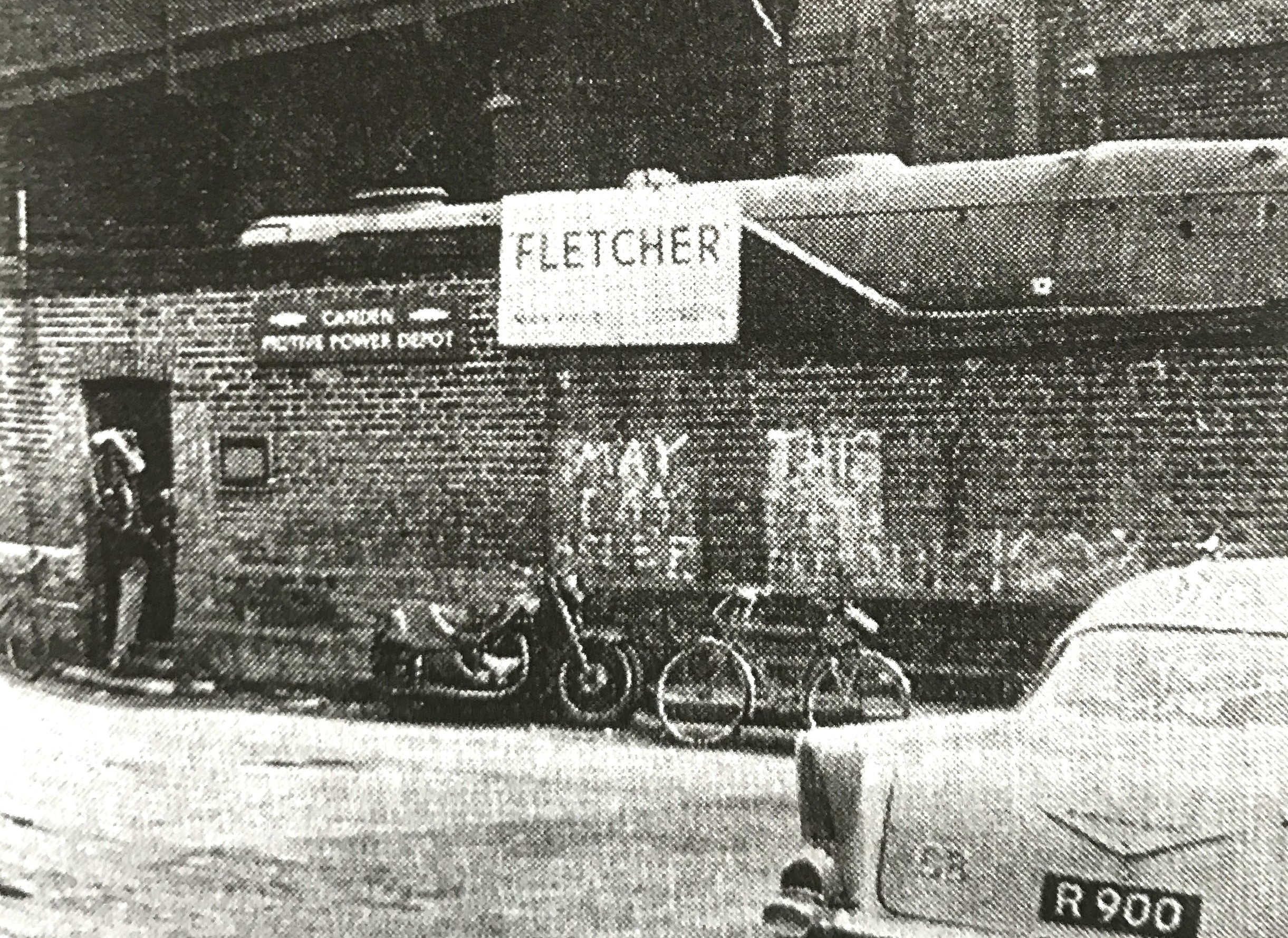
For over a hundred years Dumpton Place played a central role in Primrose Hill’s industrial history. It was the main link between the area and Camden Goods Yard. At its end, on the other side of the railway’s boundary wall, stood the enormous Passenger Engine Shed, much larger than the Roundhouse. Later known as the Camden Motive Power Depot, or simply the Camden Shed, it was reached by a footbridge over two lines until it was demolished in 1966. As the railway was the major employer in the area and owned the Railway Cottages, used to house railway employees, on the site of what is now Auden Place, many of those living in Primrose Hill crossed this bridge on a daily basis. The footings of an earlier entrance can also still be seen. The employment provided by the Camden Goods Yard came, however, at a price. The steam engines being serviced and coaled at the Passenger Engine Shed, together with the hundreds of engines hauling trains up from Euston every day, covered the area in soot, with flakes an inch thick floating in the air. The resulting grime made the hanging out of washing impossible until the introduction of the Clean Air Act of 1956 and the end of steam locomotion.
Dumpton Place’s proximity to the railway made it a delivery point for goods coming into London. Two large sheds, on either side of Dumpton Place, were operated by Pickford’s, the carriers, in the 1880s and 1890s. These then became the processing point of Scottish herrings for Mac Fisheries, the leading fish retailer founded by Lord Leverhulme. The herrings were kippered in a smoking shed at the back of 46−88 Gloucester Avenue. The whole area would have reeked of fish – but excellent fish was therefore available in the local pubs, including The Lansdowne, which opened early in the morning to serve thirsty railwaymen coming off nightshift. The sheds also at one time worked as a large-scale laundry.
Recent Developments
More recently, both sides of Dumpton Place were a Volvo repair workshop. The sheds, although a Mecca to Volvo owners in Camden and further afield, were obvious candidates for redevelopment. While there were reservations about the actual plans for offices and mews houses, submitted in 2012, what was particularly objectionable to local residents was the proposal to change the name of Dumpton Place to Jasmin Mews. Luckily, Camden’s unilaterally announced decision to change the name without proper consultation was flawed, using a postcode which referred only to one side of the street. Following a vigorous local campaign, which drew widespread support, the glorious name of Dumpton was retained. If the name of the road as a whole stayed unchanged, the developments on either side were given the appropriate names of Whittlebury Mews East and West, recalling the country estate of the third Lord Southampton, who had owned the whole area until 1840.
It must be noted that, by the time the developers’ application was made, the element of ‘Dump’ in the name of Dumpton Place had acquired new connotations to modern ears. To be down in the dumps was to be depressed. A place that was a dump had little to recommend it, while to be dumped by your spouse, partner or friend ended the relationship. Another sense derived from the American use of the word, in the first instance in military usage as an army stores depot. It was then extended to piles of discarded equipment, notably cars. This, however, was less offensive than the colloquial, and also American, use of the verb dump as meaning to defecate. Finally, as if this was not enough, Dumpton Syndrome, named after Dumpton Gap, where it was first observed, is a male genital defect, involving the non-development of the penis. The good news, however, is that this only affects the male dog whelk, a predatory carnivorous sea snail also known as the Atlantic winkle.