By Peter Darley
The article on Pickford’s Stables in the March 2023 edition of On The Hill described a truly remarkable complex of buildings. Built in 1857−58 to house some 250 horses, it was the largest and most sophisticated complex of stables built up to that time and remained so for the next several decades.
Pickford was the largest carrying agent throughout the 19th century for goods moved by railway, and the Camden Station of the London and North Western Railway, which the horses served, was the largest depot of the major joint stock company in the land.
Were it not for the damage inflicted by an incendiary bomb in 1943, Primrose Hill might have claimed another highly listed railway heritage site alongside the Stationary Winding Engine Vaults and the Primrose Hill Tunnel East portals (both Grade II*). The former stables adjoined and pre-dated by a quarter of a century the Grade II listed Primrose Hill School.

Surviving vestiges of the stables were demolished in the early 1970s to make way for Waterside Place. They would remain invisible were it not for the archaeological curiosity that is the Gloucester Avenue wall. A smaller section of wall remains on the boundary with Primrose Hill School. These walls reveal the stables’ external façade with its architectural pattern of windows and pilasters.
Camden Railway Heritage Trust would like to celebrate Pickford’s Stables and remind visitors and passers-by of their former significance by attaching a Red Wheel plaque to the Waterside Place Residents Association (WPRA) Gloucester Avenue wall. An application has been approved by the National Transport Trust (NTT) with the agreement of WPRA.
National Transport Trust’s Red Wheel (RW) heritage plaque scheme seeks to highlight the most important sites of transport heritage and bring them to the attention of a wider and younger audience, by the erection of bespoke commemorative plaques backed up with comprehensive websites.
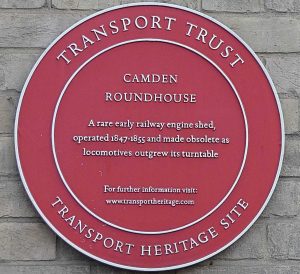
Whereas Historic England’s Blue Plaques commemorate significant people, Red Wheels commemorate significant places and ‘things’, and are precisely the same size. The Red Wheel programme is recognised by Historic England as the principal transport heritage programme. An early Red Wheel plaque on the Roundhouse is shown here.
More recent Red Wheel plaques carry a QR code that links with NTT’s website, where more information and images about the site would be found. The website would make it perfectly clear that Waterside Place is private property and out of bounds to visitors and advise that no further evidence of the former stables exists.
The NTT is already persuaded of the significance of the site, but the success of the application may also depend on a willingness to help fund the creation of the Red Wheel plaque and its installation. The installed cost is not expected to exceed £2000 and our community should be able to raise the necessary funds. There will be an appeal in a future edition of On The Hill, to be followed by details of the opening ceremony.