
By Peter Darley
In the heart of Primrose Hill, at 89 Regent’s Park Road, you will now find the elegant Lemonia, our well-known Greek Cypriot restaurant. It occupies an old building that was once the Chalk Farm Tavern, whose history over an earlier period, 1790 to 1865, is explored here.
The various types of hostelry of those days can be confusing. Taverns sold food and wine to the well-off. Alehouses sold ale, and later beer, and simple food to the lower classes. Inns provided accommodation for travellers. The public house, as we think of it today, emerged in the middle of the 19th century and incorporated elements of each of these previous kinds of hostel.

The Lower Chalcots farmhouse, known earlier as the White House, began selling ale in the 17th century, although farming continued there until at least 1732. It had become the Chalk Farm Tavern by 1790, and stood almost alone on Primrose Vale. Both the Tavern and Primrose Hill itself became a popular destination for excursions by Londoners from the 17th century until 1865.
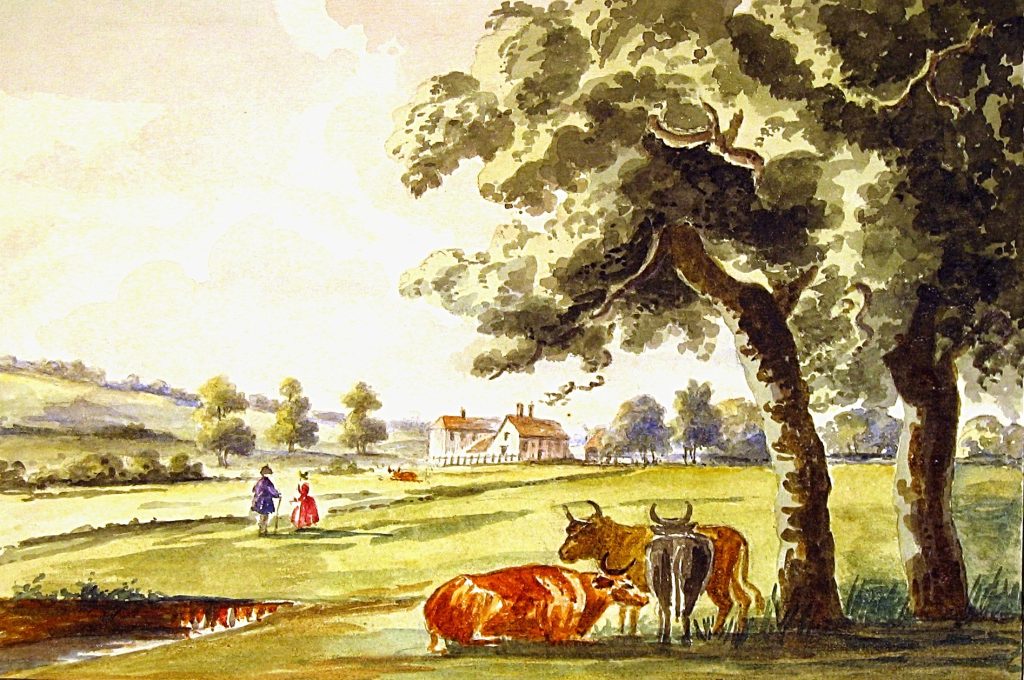
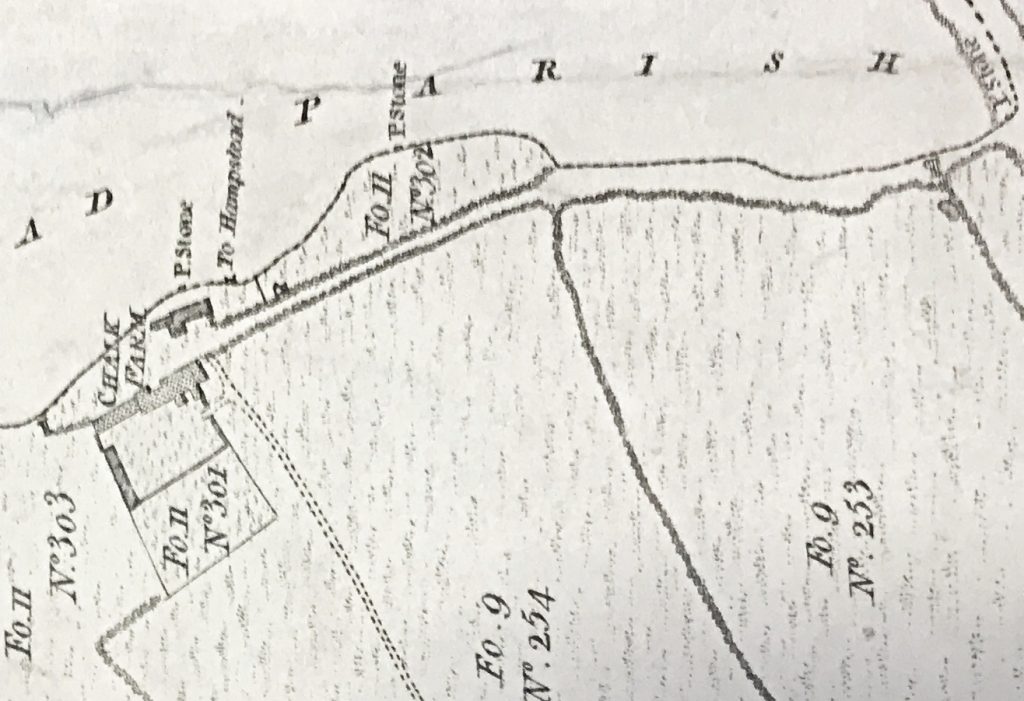
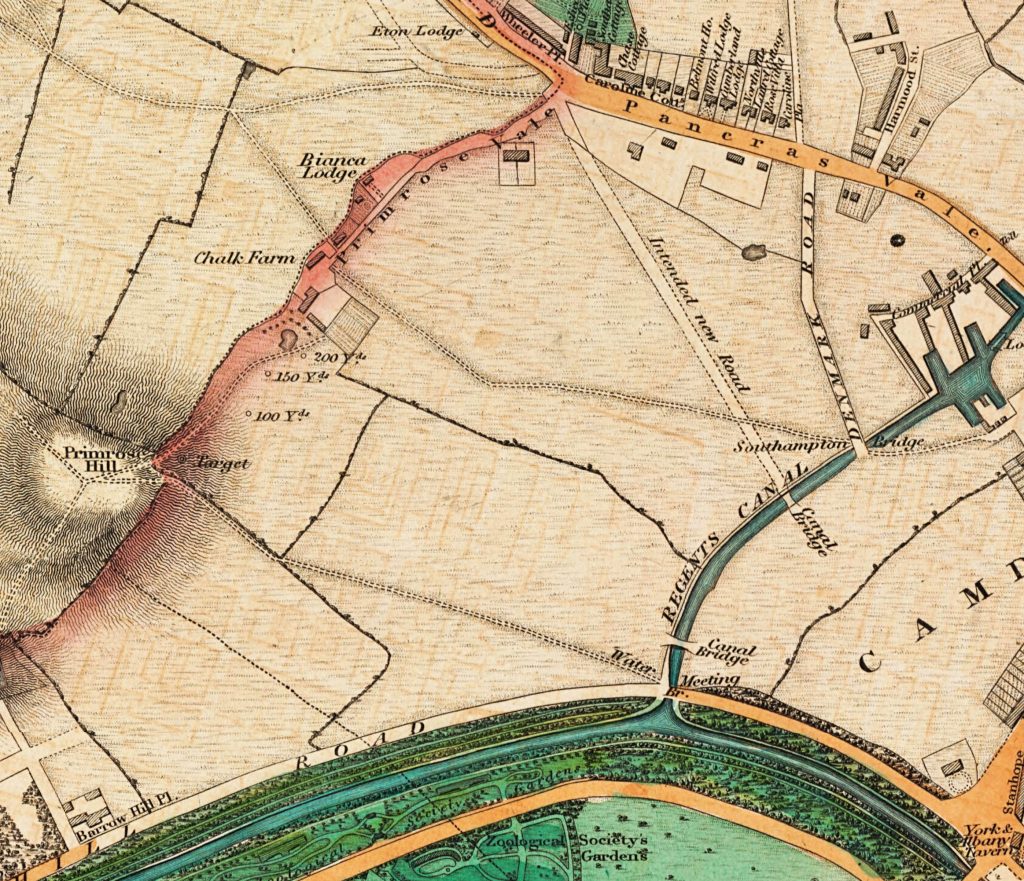
A footpath passed along the east side of Chalk Farm Tavern, crossed Primrose Vale, and continued northwards to Hampstead and the Heath. So the Tavern was also a common stop for holiday folk returning from the Heath. Where the footpath reached the Tavern, there was a turning through an arch into the Tea Gardens, which were enclosed by fencing. On the west side of the Tea Gardens was a bower to shelter customers, providing a covered area with tables and seating.
The image here shows the footpath to Hampstead evidently very busy on a summer Sunday in the 1790s, as was the summit of Primrose Hill. The Tavern could also be approached by coach along Primrose Vale, which later became Chalk Farm Lane.
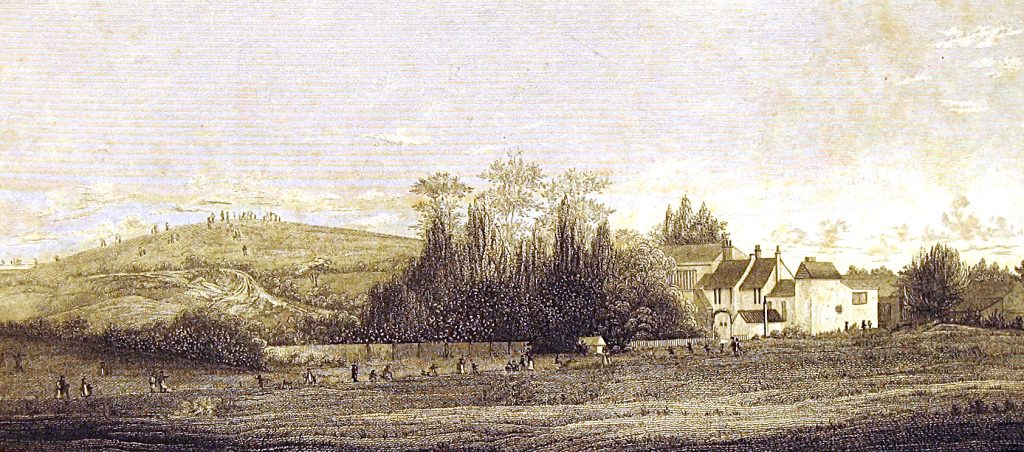
‘The Prospect from Primrose Hill’ was lyrically described in The Gentleman’s Magazine of June 1749:
‘Stella, my Muse! whose beauty prompts the song,
To whom the poet and the lays belong…
To Primrose Hill lead on the flow’ry way,
And thence the matchless scenes around survey.
Mean while the Muse shall sing, with fond surprise,
The various prospects, as by turns they rise.
The map shows the footpath to Chalk Farm Tavern with three images of the approach to the Tavern and Tea Gardens in the 1790s. On the ground floor were dining, tea and drinking rooms. From the gardens, stairs led up to the Long Room, measuring 64 by 22 feet. Several bedrooms provided accommodation for travellers.

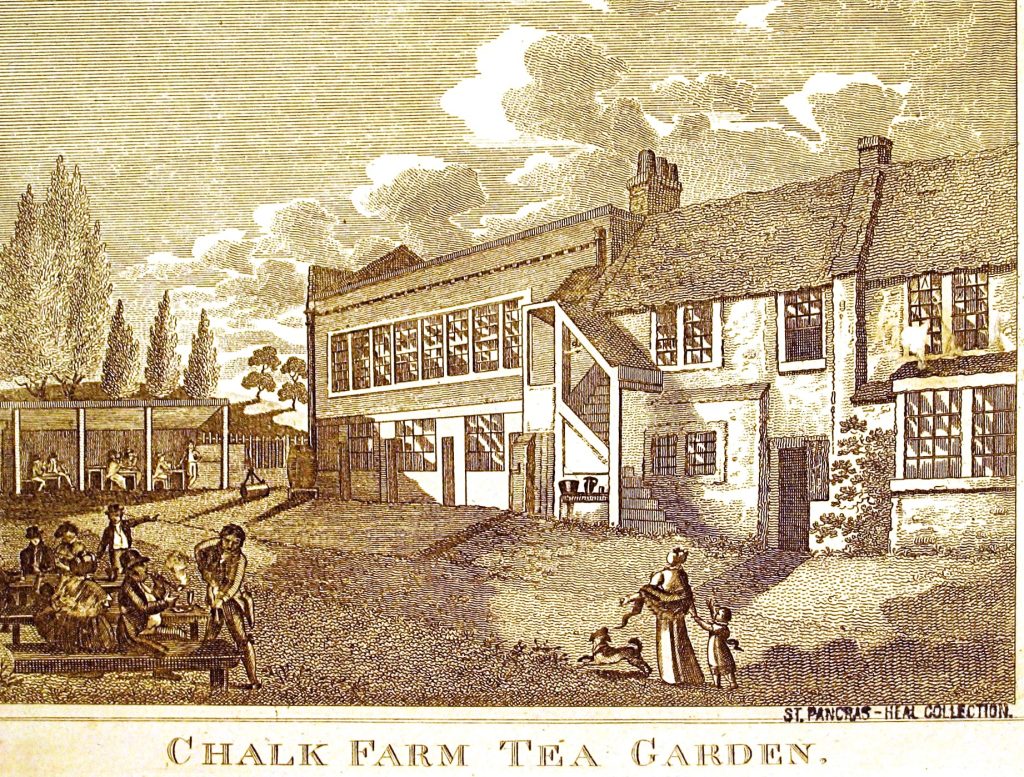
Set in 12 acres of meadow land, the Tavern was also supported by many outbuildings, including detached stables, a bakehouse, three fives courts as well as kitchen gardens. The fields around the tavern became known as ’Mr Bowden’s grounds’.
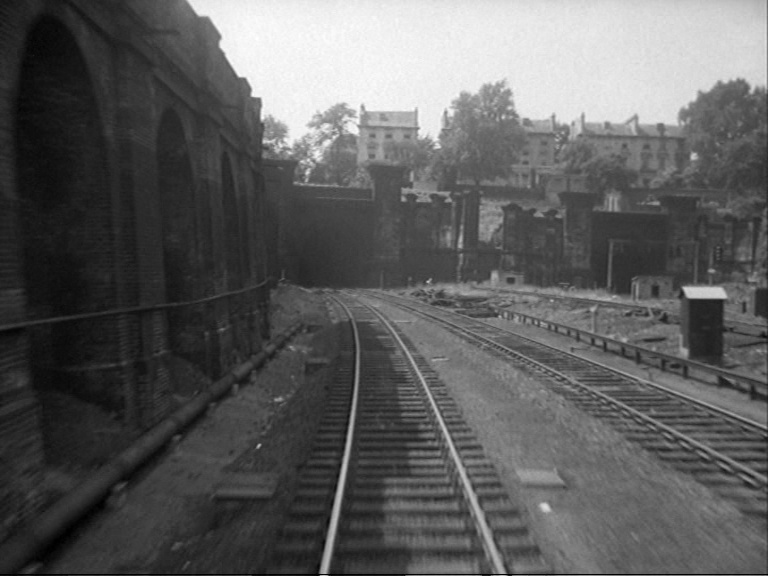
The Tavern was acquired by William Bowden in 1828 and extensively renovated in 1834. He added a new balcony, as shown, to extend the dining rooms; it commanded a full view of the railroad and tunnel under construction by the London and Birmingham Railway.
Bowden encouraged a wide variety of entertainments, including pony racing, Cumberland and Westmorland wrestling, pigeon shooting, target shooting, archery and prize fighting, all of which offered the opportunity to place bets on the competitors. He added an enclosed bowling green and skittle ground, and enclosed cricket, trap ball and quoit grounds.
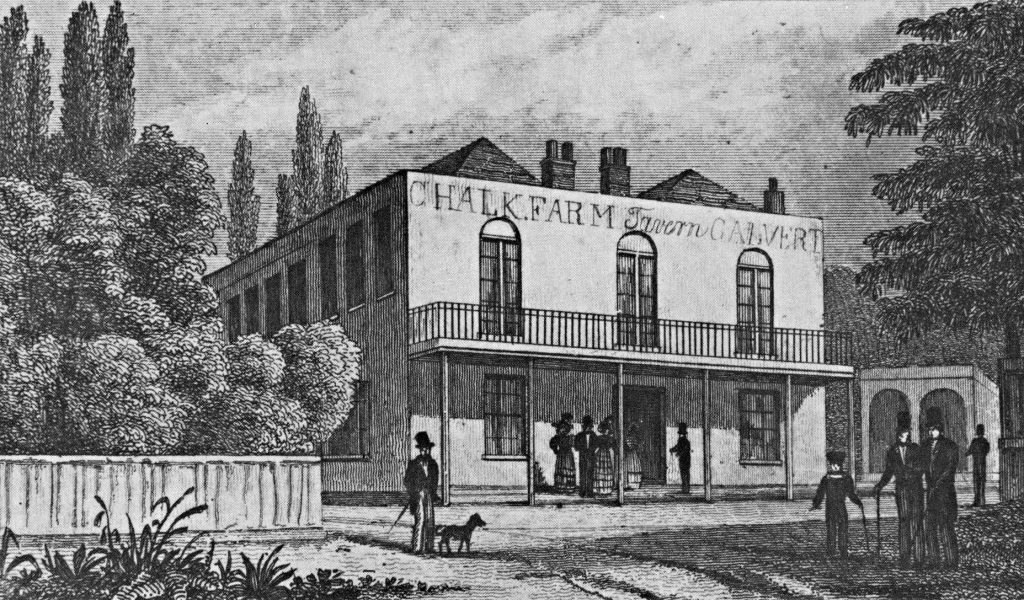
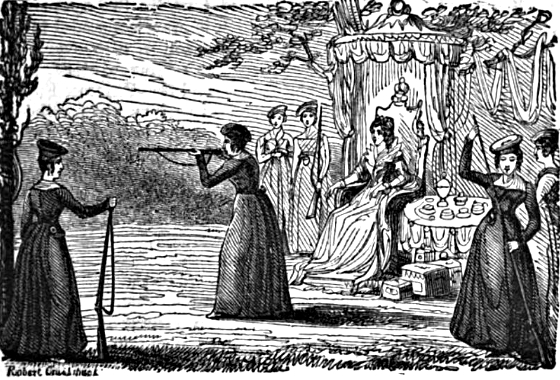
Many sporting associations held regular meetings at the Tavern. Among these was the Ladies Acrotormentarian Society (see image), the origin of whose name is obscure. But the Acrotormentarian Society of Riflemen was a civilian rifle-shooting club founded, as with dozens of other patriotic organisations, during the Napoleonic invasion scare of 1803-4; it was the only rifle club to survive the Napoleonic Wars, and held monthly meetings at Chalk Farm until 1840.
Live pigeon shooting was a very popular competitive sport, often with substantial bets of money. Great accuracy as well as speed was needed for an elusive and unpredictable target. The birds were fast-flying homing pigeons bred specifically to be shot. How many of the fallen birds would have been fit to eat is another question, touched on in David Stevenson’s memoir after the Tavern became the staff canteen for those employed by the railway at Camden station. There was a complaint that the pigeon shooting gave them ‘pigeon pies to satiety’ (Turner, 1891). The birds were almost certainly too tough for the pigeon breasts to be served as fine fare.
While the sports that Bowden encouraged were intended to stimulate the custom of the more prosperous classes, they also inevitably attracted the less wealthy. Primrose Hill was readily accessible to and frequented by all classes of the community, including the rougher elements. Prize fighting was hugely popular with the masses. Fights would often be arranged informally in the fields around the Tavern.
In 1825, following an inquest on a fatality, the coroner made a clear, and perhaps counter-intuitive, distinction between a quarrel and a prize fight: any fatality in the former had no malicious motive and therefore, while not legal, could be treated leniently; whereas in the latter, it was wilful murder.
A second report, in 1834, concerned crowds flocking to a fight on the north side of Primrose Hill to place bets on two women of notoriety. The police got wind of the gathering but were outnumbered by ruffians armed with cudgels, including navvies working on the Primrose Hill contract. The local police had to enlist the help of reinforcements from the Albany Street station.
In the mid-1830s, the Tavern developed various functions in relation to the railway. It was first a watering hole for the crowds that came to watch the construction and operation of the London and Birmingham Railway. Then it became a temporary resting place for the many construction fatalities, which became the subject of coroner’s inquests held at the Tavern. Also, given its proximity to the workshops at Camden goods station, where railway wagons were fabricated, a gate was made in the boundary wall of the goods station leading directly to the Tavern so that railway staff could come for a ‘daily ordinary’ (i.e. a set lunch) at the Tavern. According to the recollections of David Stevenson, the Tavern:
retained some of its faded grandeur, as a place of resort for dancing and fêtes. The large ball-room was decked with chandeliers and convex mirrors. An elevated gallery led to the tea-garden, at the entrance to which two soldiers were painted. The Chalk Farm Fair had not yet begun, but the navvies, during the making of the tunnel, had lowered the character of the place.
Chalk Farm Tavern was evidently much frequented in the mid-1830s by the navvies on the Primrose Hill contract. At night-times after work, the singing over their beer could be heard from afar.