By Martin Sheppard
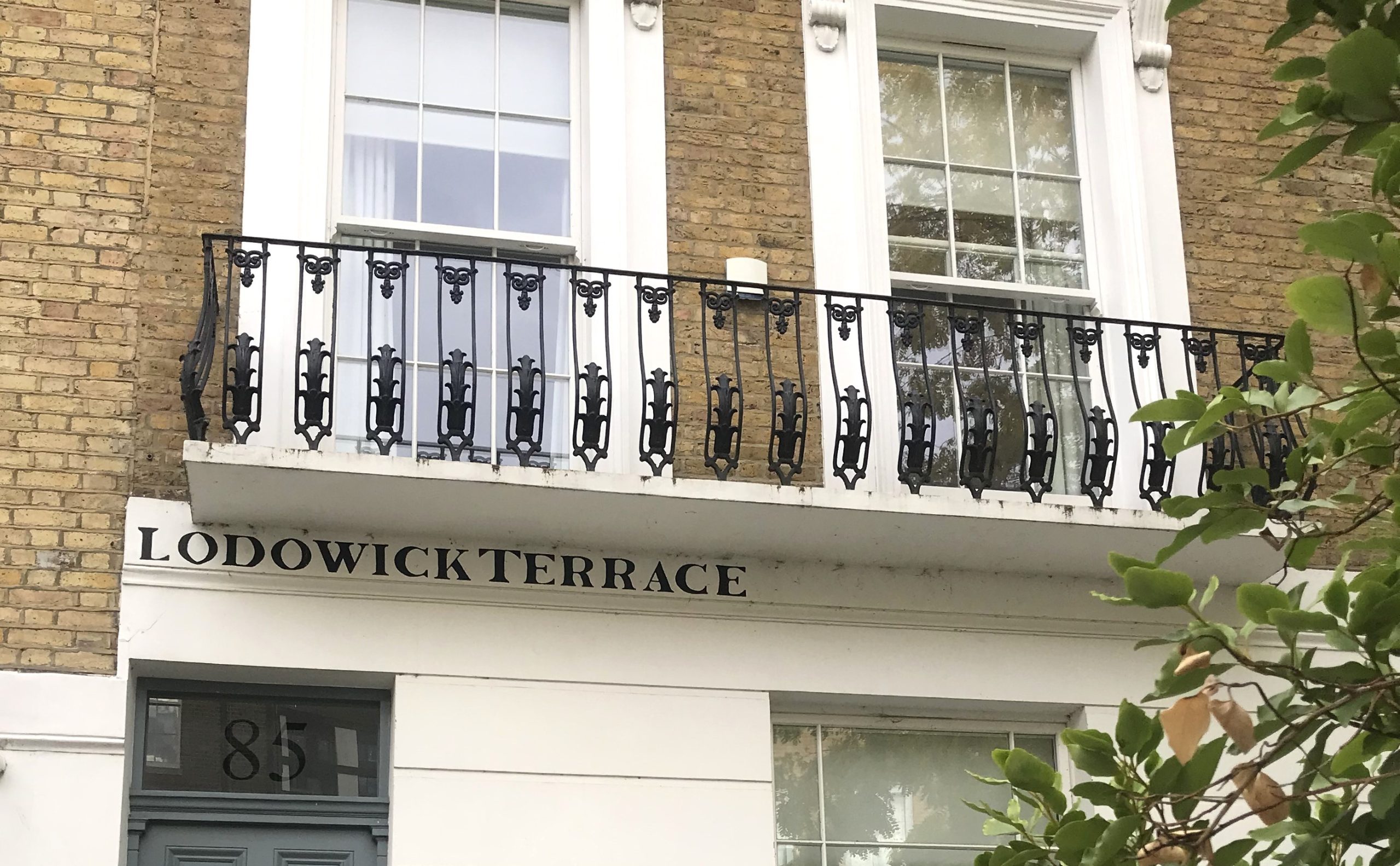
Many people walking along Gloucester Avenue must have noticed the enigmatic sign for Lodowick Terrace on the facade of no 79. Very few could probably read much into it, other than thinking that Lodowick was an unusual name. It is an anglicisation of the Latin Ludovicus, derived from the German Ludwig and the origin of the names Lewis, Louis and Luigi. There is, however, a clear reason for the existence of the sign and an explanation of its meaning.
When the stretch of Gloucester Avenue north of the canal was built in the mid-1850s, it was as a series of terraces: Lansdowne, Southampton and Pembroke Terraces on the railway side; and Waterloo, Lodowick, Fitzroy and Cirencester Terraces opposite them. This part of the street was then known as Gloucester Road North and Southampton Road, dividing at Fitzroy Road. The numbering, however, was that of the terraces, not the streets, until the present numbering of Gloucester Avenue replaced this by order of the Metropolitan Board of Works in 1867. The houses making up Lodowick Terrace were originally 1–23 Lodowick Terrace, not, as now, 79–127 Gloucester Avenue. The sign Lodowick Terrace appears on what was once no 1 Lodowick Terrace.

The reasons behind the naming of the other terraces are conventional, or at least easily explicable. Waterloo was of course an extremely popular name for streets, terraces and houses in the years after 1815. Fitzroy was the family name of the third Lord Southampton, who until 1840 had owned the whole of the local area; while Lansdowne Terrace is named after either the first or the third Marquis of Lansdowne, both prominent politicians. Pembroke and Cirencester are both well-known place names. Lodowick, however, is a distinct oddity.
Lodowick Terrace was, in fact, named after Lodowick Muggleton (1609−1698), the co-founder of a small Protestant sect dating from 1651. Following the execution of Charles I in 1649, the Commonwealth saw a proliferation of unorthodox religious views. The actual founder was Lodowick Muggleton’s cousin, John Reeve (1608−1658), but after Reeve’s death Muggleton became the sect’s leading figure. Reeve claimed that he and Muggleton were the two witnesses spoken of in the Book of Revelation, chapter 11. The Muggletonians believed that God came down to earth as Jesus (they disbelieved in the Trinity). They thought that God was between five and six foot tall, and that heaven was six miles above the earth. God, however, took no notice of human doings. Sin was only defined in people’s own consciences. The Muggletonians rejected reason as the opponent and opposite of faith.
Little was known at the time about the Muggletonians during their three centuries of existence. A peaceful and non-evangelising sect, which had no chapels and never held formal services or public meetings, they had no leader after Muggleton. They had, however, a reading room in London between 1869 and 1918, which held the sect’s records. These were removed for safety during the Blitz by Philip Noakes, a fruit farmer from Matfield in Kent, who was the last trustee of the Muggletonians’ funds. In late 1940, Noakes got a petrol voucher to deliver his fruit to Covent Garden, then drove the archive back to Matfield in the empty boxes which had held the fruit. When he died in 1959, he left the Muggletonian archive to the British Library.
“They thought that God was between five and six foot tall, and that heaven was six miles above the earth.”
The combination of having a memorable name, but being little known themselves, sometimes led to their being misrepresented as fanatical extremists. One prominent author to fall foul of the Muggletonians in this way was Sir Walter Scott in his novel Woodstock. He was sent a formal curse, dated 18 July 1826: “The writer of this, a believer in the Commission of the Spirit, commonly called a Muggletonian, has had his attention directed to certain expressions in disparagement of his most holy faith contained in a novel called Woodstock of which you are the author.” After explaining the beliefs of the sect, the writer ended:
Such are the principles of the Muggletonians, which you have pronounced to be foul and blasphemous heresy, and in so doing you have committed the unpardonable sin against the Holy Ghost which is neither forgiven in this world nor in the world to come in consideration of which I declare that you the author of Waverley are cursed and damned both in soul and body from the presence of God, elect men and angels to all eternity. I am, sir, your obedient servant, A Muggletonian.
Although all this connects Lodowick Terrace to Lodowick Muggleton, it does not explain why the terrace was named as it was or who named it. There is again a clear answer to this. Joseph Gandar, who bought the two lots in Lord Southampton’s sale on which Lodowick Terrace and Lansdowne Terrace were subsequently built, was a prominent Muggletonian. Giving his address as 19 Addington Place, Camberwell, he paid £441 for Lot 245 and £556 for Lot 246 in 1840. Soon after buying these, he built nos 1 and 3 Fitzroy Road, the only villas near Gloucester Avenue north of the canal, on part of Lot 245. He was living at no 1 by 1851 at the latest; and in the five years which followed, he developed both Lodowick and Lansdowne Terraces.
A reasonable amount is known about Gandar, originally a successful confectioner by trade. The son of John and Sarah Gandar, he was born in Shadwell on 8 October 1787. This is recorded in the non-conformist register. He was, however, as was typical for Muggletonians, christened and married in an Anglican church. His wife, Eliza Spooner, whom he married in 1807, was eleven years older than him. Together they had a son and a daughter. According to both the 1851 and 1861 censuses, Joseph and Eliza Gandar were living at 1 Fitzroy Road with two servants.
Joseph Gandar died on 3 May 1868, aged eighty. The address delivered by John Aspland, at the Muggletonian meeting to celebrate his life, was subsequently printed.
For more than sixty years, our dear brother was a believer in the Commission of the Spirit. For more than sixty years has he struggled and contended against the powerful ‘Prince of Error’, Reason … His store of heavenly knowledge surpassed (I think) any of the believers of the present age. And his faith shone, as the sun at noonday.
He was buried at St James’s Chapel, near Euston, from which his body has now been sacrilegiously exhumed by the perpetrators of HS2, who deserve a Muggletonian curse more certainly than Sir Walter Scott.
“The Muggletonians rejected reason as the opponent and opposite of faith.”
In his will, drawn up in 1864, Joseph Gandar left freehold houses at no 1 Lansdowne Terrace, nos 15 to 22 Lansdowne Terrace and nos 5 and 7 Lodowick Terrace in trust to benefit the issue of his daughter, Eliza Mary Wilson.
The fortunate survival of a set of documents to do with the title deeds of 113 Gloucester Avenue (originally 18 Lodowick Terrace) gives an insight into how Lodowick and Lansdowne Terraces were built. With Gandar retaining the freehold, they were constructed on 99-year building leases by one of the most active builders in Camden Town during this period, Richard Batterbury. As his address at the time of his agreement with Gandar was Fitzroy Terrace, it is likely that Batterbury was also the builder of this terrace. His builder’s yard was opposite Gandar’s house in Fitzroy Road.
No 18 Lodowick Terrace was built in 1853 and 1854 on a 99-year building lease agreed in June 1853. On 29 August 1854 Gandar confirmed Batterbury in a 98-year lease to run from 24 June 1854, ‘in consideration of the erection of the messuage’, a legal word for house, on a mortgage of £1,000 at 5 per cent per annum, with a ground rent of £7 per annum.
This indicates that Batterbury had now built the house as part of the terrace. A plan in the margin of the lease shows the outline of the house with an extension. The whole plot measured 90 feet 2 inches in length and 18 feet 2 inches in width, including the ‘then lately erected’ eighth house ‘southward from Fitzroy Road, the corner house inclusive’. Under the lease, Batterbury had an obligation to repair; to paint once every three years externally and internally every seven years; and to insure the house to three-quarters of its value in the names of Batterbury and Gandar.
No trade or manufacture (without written consent of the lessor, Gandar) was to be carried on, or sales by auction, or exhibition of goods for sale. The lessee was not to alter ‘the parlour window or any part of the fore front or elevation of the said messuage’; there was to be no shop in its front; and no building at its back within 15 feet of the back wall. The lessee was to yield up the house at the end of its term and to inform the lessor of any underlease.
Batterbury immediately passed on the lease to William Fisk of Western Villas, Blomfield Road, Maida Hill for £1,200 at 5 per cent per annum interest on the security of the house; redeemable on payment of principal and interest to Batterbury. It is unclear whether Fisk lived in the house or let it out.
While Lodowick Muggleton may look down from his Muggletonian heaven with satisfaction at the terrace built in his honour, we should spare a thought for his cousin and co-founder, John Reeve, and wonder whether Joseph Gandar ought in fairness to have named the terrace opposite not Lansdowne Terrace but Reeve Terrace.