By Doro Marden
Photography by Leela Ramsay
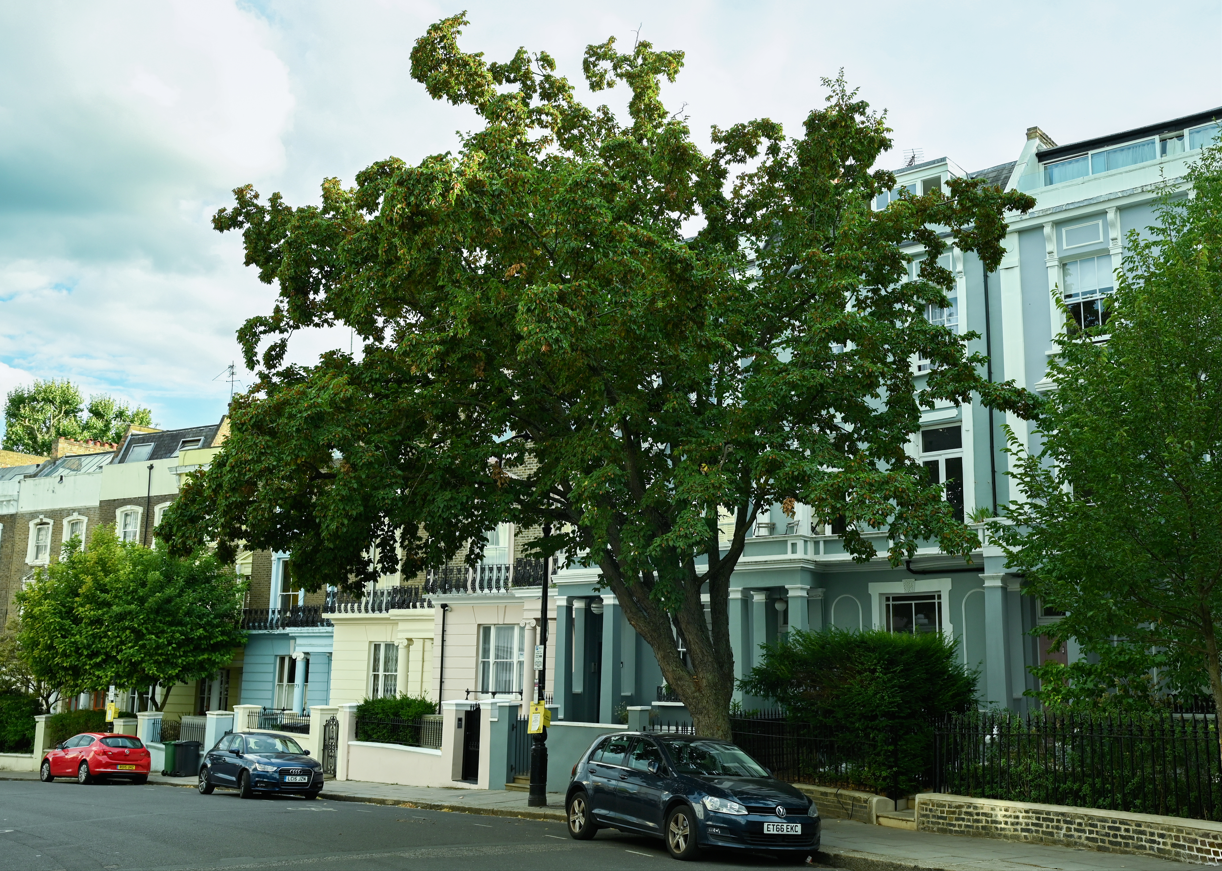
We are lucky to be living in a neighbourhood with so many mature trees; even though the summer heatwaves have been bad for trees generally, they still support insects and birds and absorb CO2 and other pollutants. Also, from a human angle, just seeing trees reduces our stress and blood pressure: research has shown that a view of trees from hospital results in patients needing less pain relief and leaving after shorter stays.

Trees help our over-heating environment by reducing urban temperatures by 2 to 8 degrees, and up to 5 degrees at night; this is because their shade reduces the heat absorbed by hard surfaces. Sadly, new street trees seem to be upright ‘lollipop’ trees, which won’t provide the canopy that larger trees provide. Insurance companies often demand that mature trees are thinned or felled (this is what happened in St George’s Terrace Gardens), so branches are brutally cut back which reduces their shade.
To cut down or prune a tree on private land in a conservation area (most of Primrose Hill) you need permission from the planning office, with an application six weeks before any work begins; you could be fined up to £20,000 if you don’t apply. And you can’t just replace a 100-year-old tree with a new sapling; see the campaign group Canopy Coalition on canopy.org.uk for lots more on this.
The worst culprit is HS2: they have felled as many as 500 trees on our railway embankment, as well as lots of mature trees around Euston and Hampstead Road. According to the Woodland Trust, 55 ancient woodland sites have been affected by the route to Birmingham. Ancient woodlands are irreplaceable stores of complex biodiversity, and once gone they are gone for ever.
What are your favourite trees locally? Maybe the magnificent London planes in the park alongside Regent’s Park Road; or the cherry trees in Chalcot Square. One of those is a Tai Haku with especially large blossoms; this tree was extinct in Japan, where all these ornamental cherries originate, until one was found in a Sussex garden in 1923 and reintroduced worldwide.
If you want to identify a street tree, LB Camden has a ‘Camden Tree Map’ which tabulates all the trees in our streets and some of the estates. However, the magnificent ash in Auden Place doesn’t seem to be shown, and despite ash trees being decimated by Chalara ash dieback, this one still looks healthy. Another interesting tree is the Hop Hornbeam at the top of Gloucester Avenue: it has beautiful catkins in spring, which turn into papery fruits that resemble hop cones.
Primrose Hill park has some wonderful trees, for example a native Black Poplar, one of Britain’s rarest and most endangered trees; also a rare semi-evergreen oak called Spencer Turner, a hybrid dating from the eighteenth century.