By Anna Moszynska
The Primrose Hill Community Association hosted a fascinating evening at the Community Centre at which art historian Jeremy Lewison gave an illustrated introduction to the history of artists’ studios in Primrose Hill from the 1960s to the 1980s. Two distinguished Royal Academicians, Michael Craig-Martin and Paul Huxley, then shared their recollections of working in the neighbourhood.
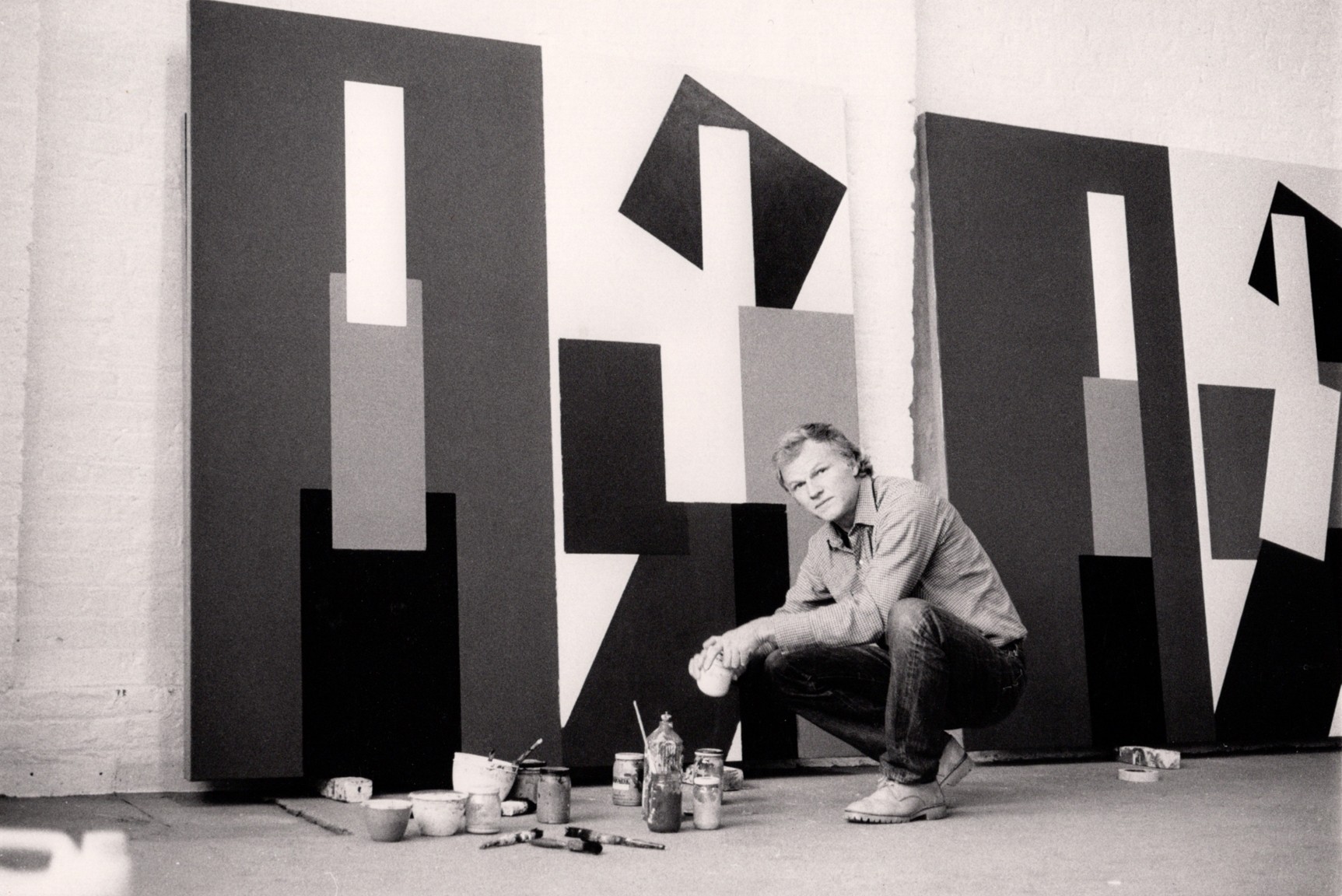
The two artists had overlapped during the 1980s, renting studios in Butcher’s Yard, the plaster workshop named after its owner, Mr Butcher, at 6−10 Fitzroy Road. Each had previously lived and worked in New York lofts, which they found a very different experience. There, they discovered generously proportioned studios functioning as a joint work/home space, and providing welcome heating, if not air-conditioning.

But at Butcher’s Yard, Craig-Martin found his studio small, perilously cold and lacking hot water. Both remembered ‘surreal’, De Chirico-esque encounters with unpainted plaster columns and piles of white ceiling roses in order to reach their respective studios, and Huxley recalled how even the smell of the place became insalubrious after the workshop turned to using fibreglass instead of old-fashioned plaster.
But benefits abounded: the enticement of artist friends living or working in the area; stylish Regent’s Park Road with its bookshop and other amenities; and proximity to the heart of London, plus the advantage of high ceilings in the studios themselves. Craig-Martin, who was living in a basement in Regent’s Park Road, found the area more congenial than the Angel, which was yet to ‘up and come’. From his own studio in the top storey of the Yard, Paul Huxley could hear the roar of lions and sea lions from the Zoo and, while painting late at night, even the howl of wolves!
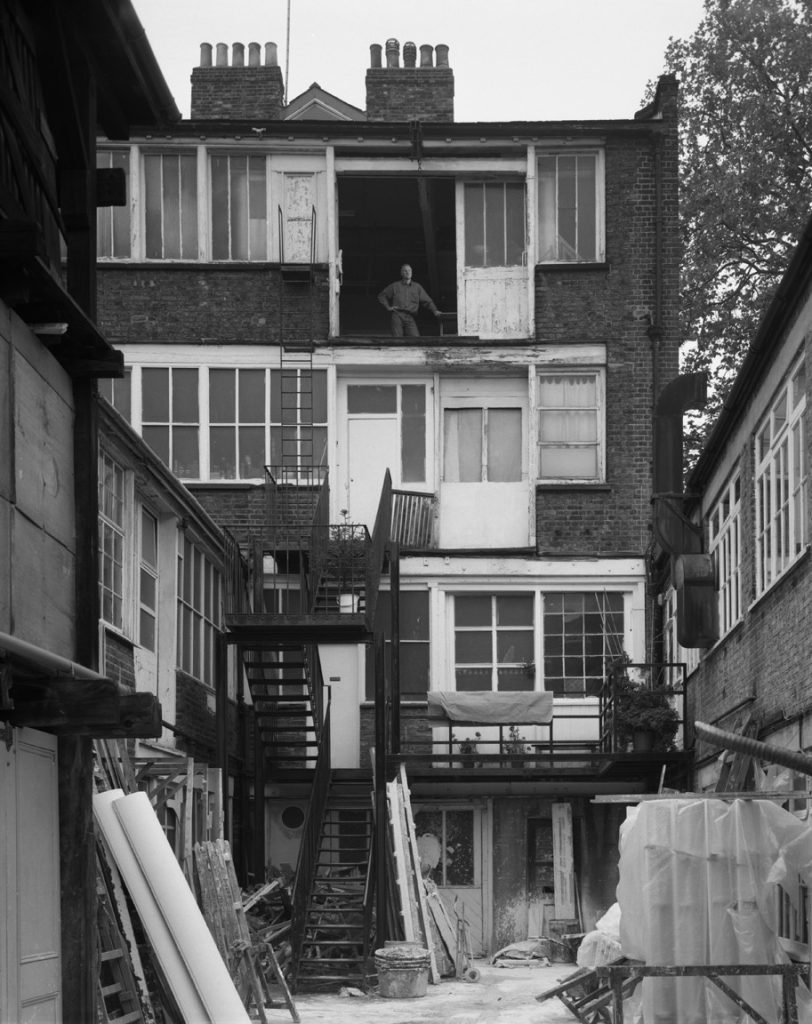
Both artists felt an effect on their art: Huxley responded to the north-facing light, and Craig-Martin particularly enjoyed being part of a properly functioning industrial environment. In this he was helped by the sculptor Julian Opie, whose welding skills led him to a phase of metal construction before his young assistant set off to pursue his own career. Huxley was surprised to learn that a live blowtorch was being used by his colleagues just a few floors below him, with gas storage tanks in close proximity. Health and safety would have a field day now!
While Hampstead was known for its ‘nest of gentle artists’ in the 1930s (Hepworth, Nicholson and Moore), what this evening brought to light was just how many respected painters and sculptors, only a few decades later, worked in Primrose Hill. Besides Frank Auerbach coming in from Camden, in Fitzroy Road alone Butcher’s Yard hosted Robert Adams, Stephen Buckley, Rita Donagh, Peter Kalkhof and Phillip King; while on the other side of the street, Primrose Hill Studios was home to Patrick and Pauline Caulfield (the latter still living there) and John Hoyland. Today, high London rents have made Folkestone, Margate and Hastings the go-to destinations for young artists, but as Craig-Martin pointed out, the loss of city-living has been a loss to them. And also, one might argue, to us.
Jeremy Lewison’s recent book, Paul Huxley, published by Lund Humphries, is available from Primrose Hill Books and other bookshops