
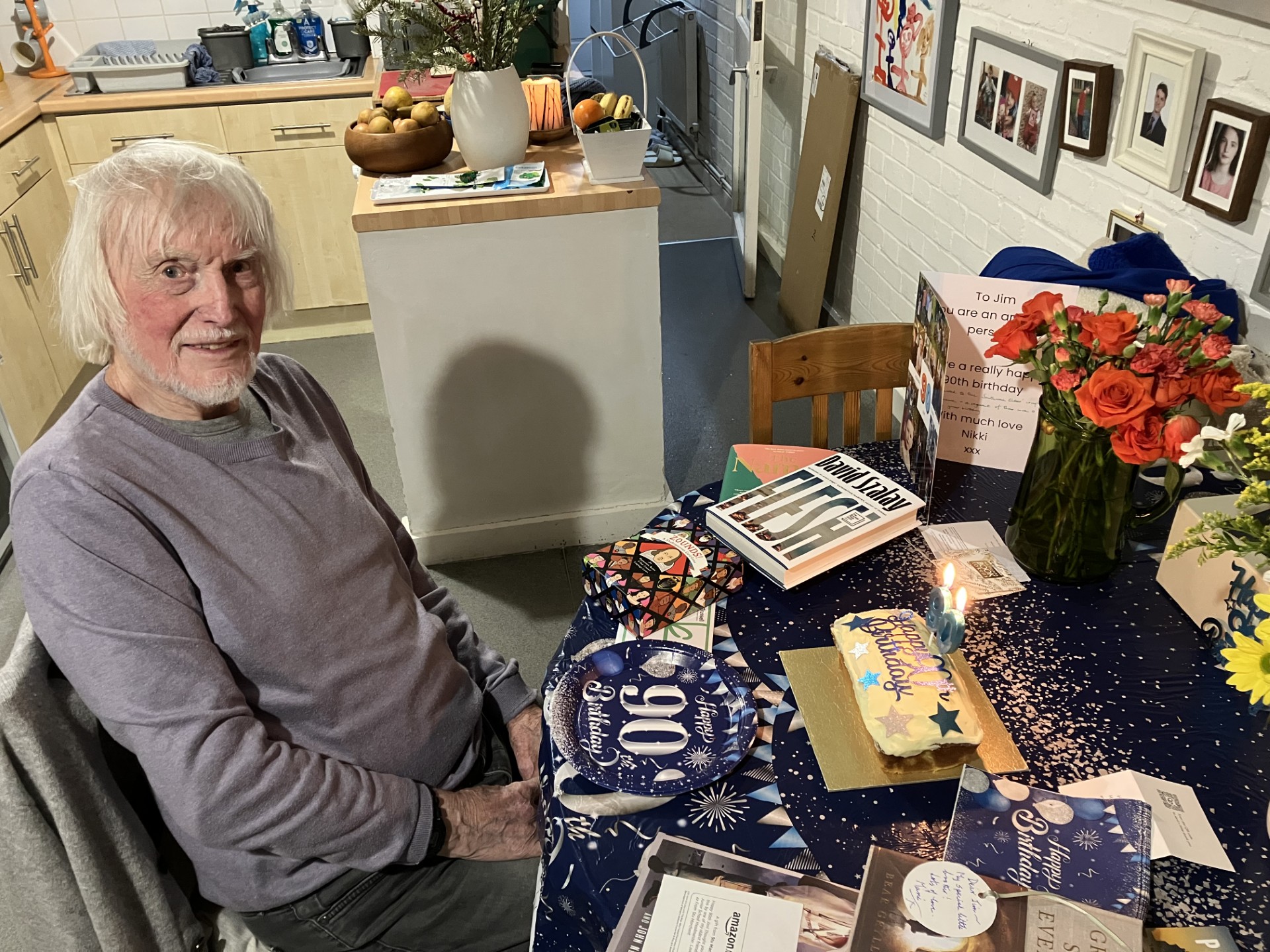
By S.L.
There is a quiet magic in not knowing who is watching over you. For twelve years, the residents of Primrose Hill have been observed, reported upon and gently held to account by what many thought was a creature none of them could quite place: a column-writing mole with sharp eyes, a dry wit and an opinion on absolutely everything about the unique residents of the Hill.
His identity was the neighbourhood’s best-loved secret; but now, with his 90th birthday behind him, as he sets down his pen, the Mole has agreed to step out of the shadows.

So who is the Mole on the Hill? His name is Jim Mulligan: retired teacher, writer, father of six, grandfather, journalist, volunteer, actor, and one of the most quietly remarkable people ever to have called Primrose Hill home.
From Middlesbrough to the Top of the Hill
Born in Middlesbrough, after his schooldays Jim spent four years in a seminary in Ireland before coming to London to train as a teacher. He began at St Gerard’s School in Clapham at age 24, then taught at three further London schools, finally as Head of English at Pimlico; he retired at age 57 after 33 years in the classroom. Along the way he squeezed in an English Literature degree part-time at what is now Middlesex University, and later an MA in novel writing, because for Jim Mulligan learning has always extended beyond any formal obligation.
His arrival in Primrose Hill came through a Labour Government scheme enabling teachers and essential workers to rent properties from housing associations near their place of work. This meant that he and his wife Nikki Haydon, who taught at Haverstock School, could take up the offer and settle on the Auden Place estate in 1983. He has lived here now for 43 years, long enough to have witnessed the transformation of the neighbourhood. When he arrived, some railway workers still lodged in the large multi-occupied houses that have since become family homes, though the railway cottages had already passed into private ownership. Today the area is one of the most photographed, most visited, most talked-about neighbourhoods of London.
The BBC, the Books and the Burrowing
When Jim retired from teaching, the BBC rang almost immediately and asked him to do interview work for The English Programme, a series that sent him touring schools across the country. After that came Methuen, where he continued interviewing and writing, and then Community Service Volunteers, where he worked as a staff writer producing books on volunteering and on training teachers: this combined the fruits of his 33 years teaching and his experience in volunteering to give him the satisfaction of writing about how to volunteer.
It was somewhere in all this − the schools, the interviews, the community work, the long walks on the Hill − that the Mole was born, though Jim will tell you the animal had a precursor: a ferret, which he invented when a teacher to host a column for the school magazine. This animal-columnist device had proved so useful and so freeing that when the editor of On The Hill magazine, Maggie Chambers, came looking for a writer, his instinct was already well-established.
The Mole, Revealed
The conceit was elegant: a mole looking down from the top of Primrose Hill, observing the world below with curiosity and no particular agenda. Jim has written dozens of articles under the Mole’s byline over the years. The character grew as Jim grew comfortable in him, and at some point he gave the Mole a granddaughter, inspired by his own grandchildren: a small girl who would tug at her grandfather’s hand and ask, “Grandad, what’s that down there?” It gave the column permission to explain, to wonder aloud, to treat the neighbourhood as worthy of understanding rather than merely recording.
He has decided to stop writing for the magazine for the simplest of reasons: he turned 90 in January, and 90 felt like the right moment; though he did pause to note, with a gleam, that his retirement may not be entirely permanent.
Six Children, 43 Years, and a Neighbourhood That Keeps Changing
Jim has six children, none of whom seem to have taken the obvious path, which is perhaps the most Jim Mulligan thing about them. Jim also has several grandchildren who are distributed across Bath, Derbyshire and London.
The neighbourhood, Jim will tell you, has changed in ways both visible and less so since he arrived 43 years ago. Sunday mornings are busier now, thick with tourists climbing the Hill to look across at the skyline. The park closes at 10 pm, a change brought in partly to control the drug activity that used to cluster there after dark. Jim is familiar with the problem from having interviewed those working on the front line. He knows that knife crime among local young people is a more present reality than the neighbourhood’s elegant exterior might suggest.
The area’s working-class roots have given way almost entirely to architects, artists, yoga studios and coffee shops. Jim watches this with the clear-eyed objectivity of someone who has been here long enough to remember several different versions of the same Hill.
Still on Stage, Still in the Room
What is perhaps most striking about Jim Mulligan at 90 is that he doesn’t seem to be stopping any time soon: volunteering at the Community Centre, helping with washing up at the Wednesday community café, performing songs and readings at care homes, and attending a splinter group of Southwark elders every Monday, a habit sustained by a genuine and undiminished love of being in a room where theatre is being made.
Jim co-ran the summer fair in Chalcot Square for years, alongside his late friend Keith Bird. He still sees volunteering not as an optional extra of Primrose Hill life but as its connective tissue, the contribution that holds the Community Centre, the Library and half a dozen other essential enterprises together.
Jim has also written plays and poetry. When asked where his love of writing began, Jim says he has been a writer for as long as he can remember. Having left home at seventeen to enter the seminary, he was required by his mother to send weekly letters home, a rule she enforced across all nine children. He didn’t realise it at the time, but the memory of those letters remains the closest thing to a sustained personal record he has, and he suspects they are what made him a writer in the first place: not any formal programme or creative epiphany, but simply the discipline of having to find something to say every single week, whether you felt like it or not.
The View from the Hill
The Mole may have put aside his column, but Jim is still very much on the Hill, still writing, still watching, still involved, still turning up for the community.
Before we finished our interview, Jim asked me, with the mischievous directness of someone who has spent decades interviewing other people, whether perhaps I might be the next Mole on the Hill. I said I could never be. There is no one who can take his place, and it would be a disservice to the column and to the neighbourhood to pretend otherwise.
When I suggested that 90 is not, in the grand scheme of things, a definitive reason to retire, and perhaps there was room for a yearly comeback, a special dispatch from the Hill, he paused and said with a smile that suggested retirement denoted rather more flexibility than advertised: “I might come back. You never really know.”
And with Jim Mulligan, the Mole on the Hill, you really never do.
Jim Mulligan wrote the Mole on the Hill column for On The Hill magazine for twelve years. Even though he has reached the grand age of 90, he reserves the right to make a comeback.