The trustees of Engels House write about the world-famous political philosopher’s important connection to Primrose Hill.
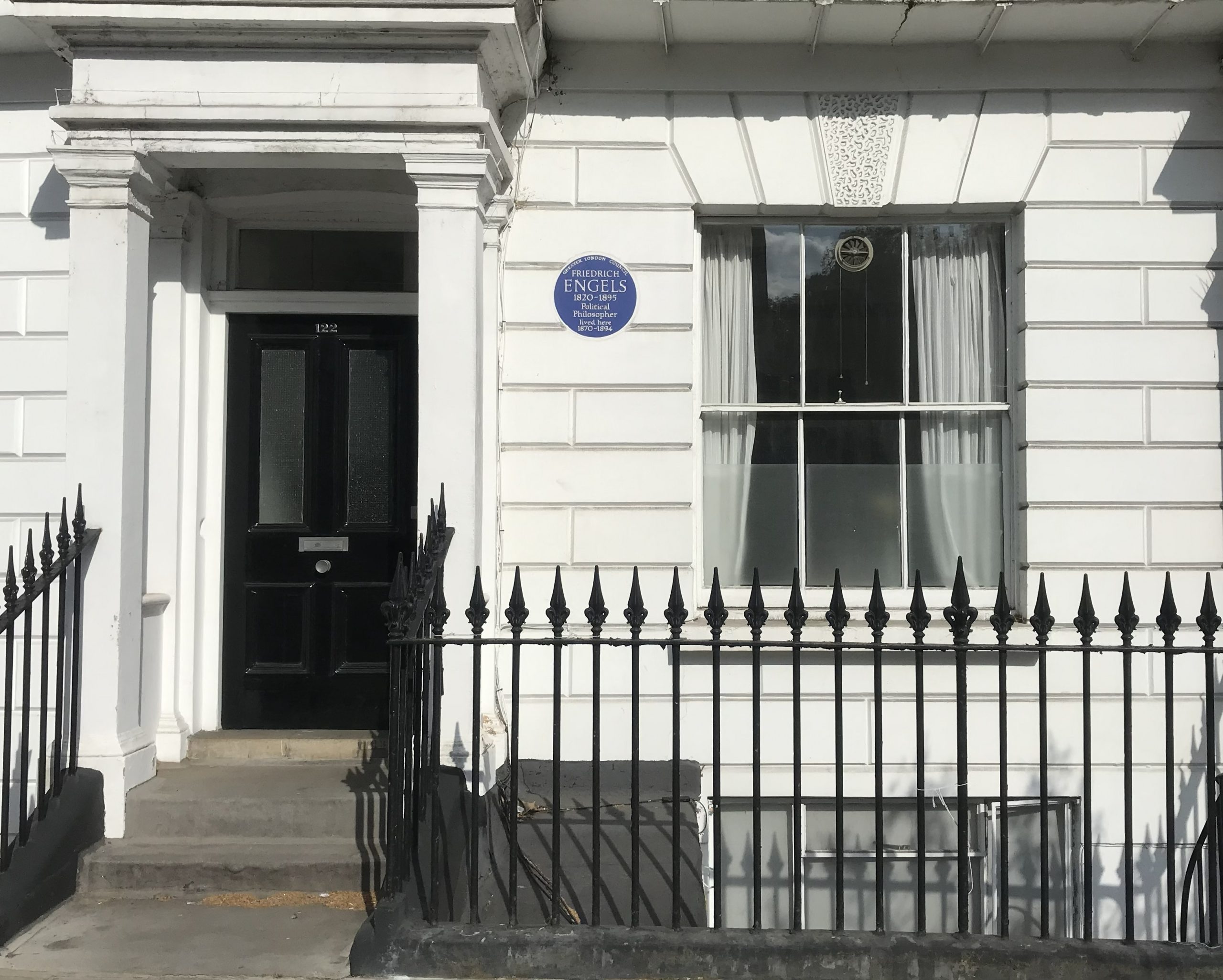
When walking along Regent’s Park Road near to Primrose Hill, you may notice the blue plaque at Number 122. It reads: ‘Friedrich Engels 1820−1895 Political Philosopher lived here 1870-1894’. But many people will not know the full story of how this elegant Victorian townhouse came to hold such an important place in local, national and even world history.
Engels lived at 122 Regent’s Park Road for the last 24 years of his life. By the time he arrived he was already a well-established writer and significant intellectual figure across Europe. He is best known today as the lifelong collaborator with his close friend Karl Marx, with whom he co-authored The Communist Manifesto in 1848. Yet there is much more than just political ideology that makes Engels’ connection to Primrose Hill so interesting.

Engels chose this area for a reason. Then, as now, Primrose Hill was a desirable and upmarket part of London. A man of Engels’ background would have fitted in quite well in this part of town. But he was a man of many contradictions: a successful factory owner during the Industrial Revolution, a keen fox-hunter and lover of good food and expensive wine, who nonetheless devoted most of his life to studying poverty and theorising revolution. Despite his own personal wealth he became a champion of the working class, who he understood to be central to social change.
It was from his first-floor study − which remains to this day − that Engels worked on many of his most influential works and edited key volumes of Marx’s Capital after their death. His Sunday gatherings on Regent’s Park Road became legendary. Each week his home became a melting pot of assorted radical politicians, trade unionists and intellectuals from across Britain and the world. These gatherings were lively, sociable affairs, with intense debate and raucous humour in equal measure. It is said that nobody left until the early hours of the morning.
Throughout his life, Engels’ writings focused on issues that remain strikingly familiar today: the poor conditions of housing and the workplace, the extremes of wealth and poverty and the oppression of women. His book The Condition of the Working Class in England was a foundational sociological study of industrial life. His work exploring the family was pioneering within socialist feminism. His ideas about nature made him one of the earliest ecological thinkers.
This body of work is still influential across the world and hotly debated to this day. Much of it was developed right here in Primrose Hill.
While many local residents may not share all of Engels’ political conclusions, the questions he raised − about poverty, inequality and environmental destruction − continue to resonate in modern Britain, especially here in the Borough of Camden, which has one of the highest rates of child poverty in the country.
But other than the blue plaque, there is little to mark Engels’ presence in Primrose Hill. In fact, there are no heritage sites related to Engels in Britain at all. That is why 122 Regent’s Park Road matters.
The house was left in trust by Caroline Read, who sadly died in 2020 after living there for 34 years. As a school librarian of many decades she cared passionately about education, especially refugee children’s access to books. She was deeply committed to protecting the building’s heritage. As trustees, we see the house not simply as a memorial, but as a potential community resource: a place for learning and support.
We are keen to speak with people in the Primrose Hill community about how this remarkable heritage can be respected and shared. Whether your interest is historical, architectural or simply local, we would welcome the chance to explore together how Engels’ house can make a positive contribution to this area.