By Jasmine Larché.
Photograph by Christina Jansen.
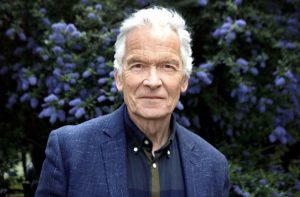
On Tuesday afternoons at the Primrose Hill Community Centre, an extraordinary group of singers gather together. Led by Martin Nelson, singer, actor and environmentalist, the Memory Singing Circle is for people with dementia and other neurological conditions, who come together to connect, forge new friendships and delight in the joys of music. Martin says, “We sing for an hour, do rounds, comedy songs, action songs, choose from the book we’ve compiled – and end after having a bit of a bop.”

Nelson is passionate about allowing the participants to find their voice and share in his love of singing. A common symptom of dementia and other neurological conditions is the struggle to find words. “There is no doubt about it, when singing, words seem to come through a different synaptic route. Like magic, those words just come when singing.”
Martin varies the songs each week, relating them to current or historic events and anniversaries. However, some elements of the sessions have become too vital to change. As a young boy Martin met Stan Hugill, the world’s last professional shantyman, and this inspired him to include a weekly shanty. “This has become an absolutely key part of the hour. A stamp-’n-go shanty (like ‘What shall we do with a drunken sailor?’) is when the whole crew pull a rope across the deck. So I get them all to sit tall in their seats, grab the (imaginary) rope and pull as they sing. The shanties all have different actions, like pushing a capstan round (‘Rio Grande’) or turning a windlass handle (‘Shenandoah’). You can feel the oxygen getting into our bodies; we sing more strongly and even get an opera quality to our voices. It’s really energising.”
In the year since the launch of the Memory Singing Circle, Martin says it has “grown into a strong community. We’re just having a nice time, trawling up memories: simply singing for the pleasure of singing together.”
Martin began singing at school. “I had inspirational music teachers,” he says. He went on to have a varied career in opera, West End musicals, film and theatre, singing on film scores like Star Wars or The Hobbit, and in more recent years as an extra-chorister. “The stage of the Royal Opera House has become my second home.”
One of the most memorable moments of his career was performing Sweeney Todd in Wormwood Scrubs prison. “Ten percent of the nation’s lifers watched me cut the throat of the prison governor. The atmosphere was electric. They were all chanting, ‘Go on! Cut ‘im! Cut ‘im! Go on!’”
In the 1980s, Martin’s idea for Scrap and Scratch operas was born. “We put on these massive kids’ operas from scratch in a single day, making the props and costumes from scrap materials. We made about 300 costumes and composed the music and words in just six hours flat! We did the Armada in Greenwich in 1988, then the French Revolution (with cast members of Les Misérables) in 1989 and a Rainforest opera in 1990, both at Kenwood Lakeside. It was chaotic but lots of fun. Professionals and celebrities (designers, composers, technicians, singers and actors) joined in. The operas were days of pure joy and adrenaline. Children came up and said, ‘That was the best day I’ve ever had.’ Never underestimate the capacity for children to absorb and create, just like that. The sky’s the limit.”
Alongside his love for music and singing, Martin has a lifelong passion for the environment. This stems from studying geography at university, and later becoming a geography teacher: “It has always been my subject.” In 1977, Martin submitted the winning design for London’s first official cycle route – Primrose Hill to Morley College in Lambeth via Waterloo Bridge. Having gained his Freedom Pass, he created London Cycle Orbital: “900 miles of recreational cycling round the capital, organised into a network of 12 Spokes, Arcs and Spin-offs.”
Another passion of Martin’s is the spring and autumn equinoxes, inspiring him to launch his movement EQ. Equinoxes are fixed events in the earth’s orbit around the sun, when there is equal day and night – twelve hours – wherever you are on the planet. He believes these days make ideal Earth Days, on which to rebalance, reconnect and act. “They bring a sense of equality. We are equal-under-the-sun at equinox. They’re planetary not human events, so can teach us much. They pre-date and will outlast us by billions of years. As EQ’s promo video says: The planet doesn’t need saving – we do!”
From a global idea to a close-knit choir in Primrose Hill, Martin’s guiding principle is clear: “So much more unites us than divides us.”