The heart of Primrose Hill for 75 years: Part 2
By Peter Darley
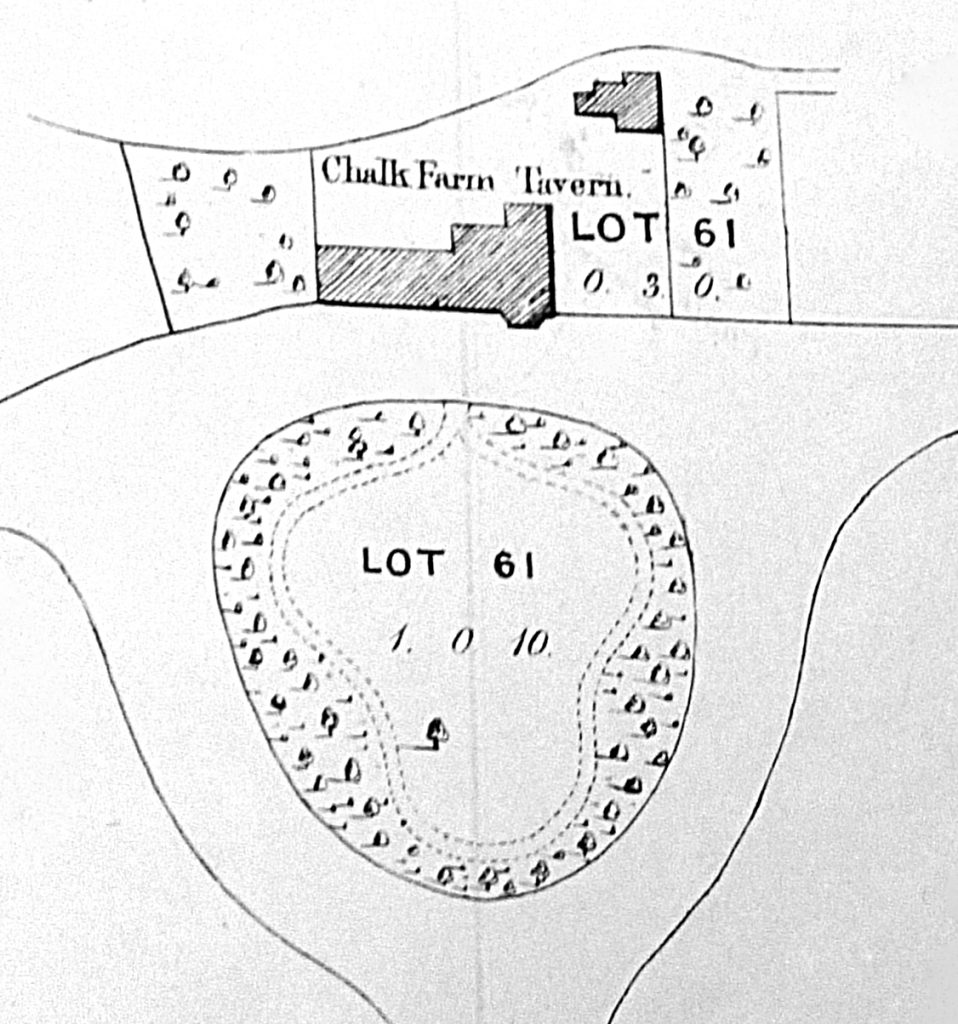
The freehold of the Chalk Farm Tavern and Tea Gardens was sold by the Southampton estate as Lot 61 on 4 May 1841 for £1,974, subject to a lease with 37 years to run. The areas in question, shown in the plan, amounted to 0.8 acres for the Tavern and its grounds, and 1.1 acres for the Tea Gardens. The Tea Gardens had been laid out with a footpath about 250 yards long. Charles Dickens alluded in 1846 to ‘the bowers for reading and smoking scattered about the tea-gardens at Chalk Farm’.
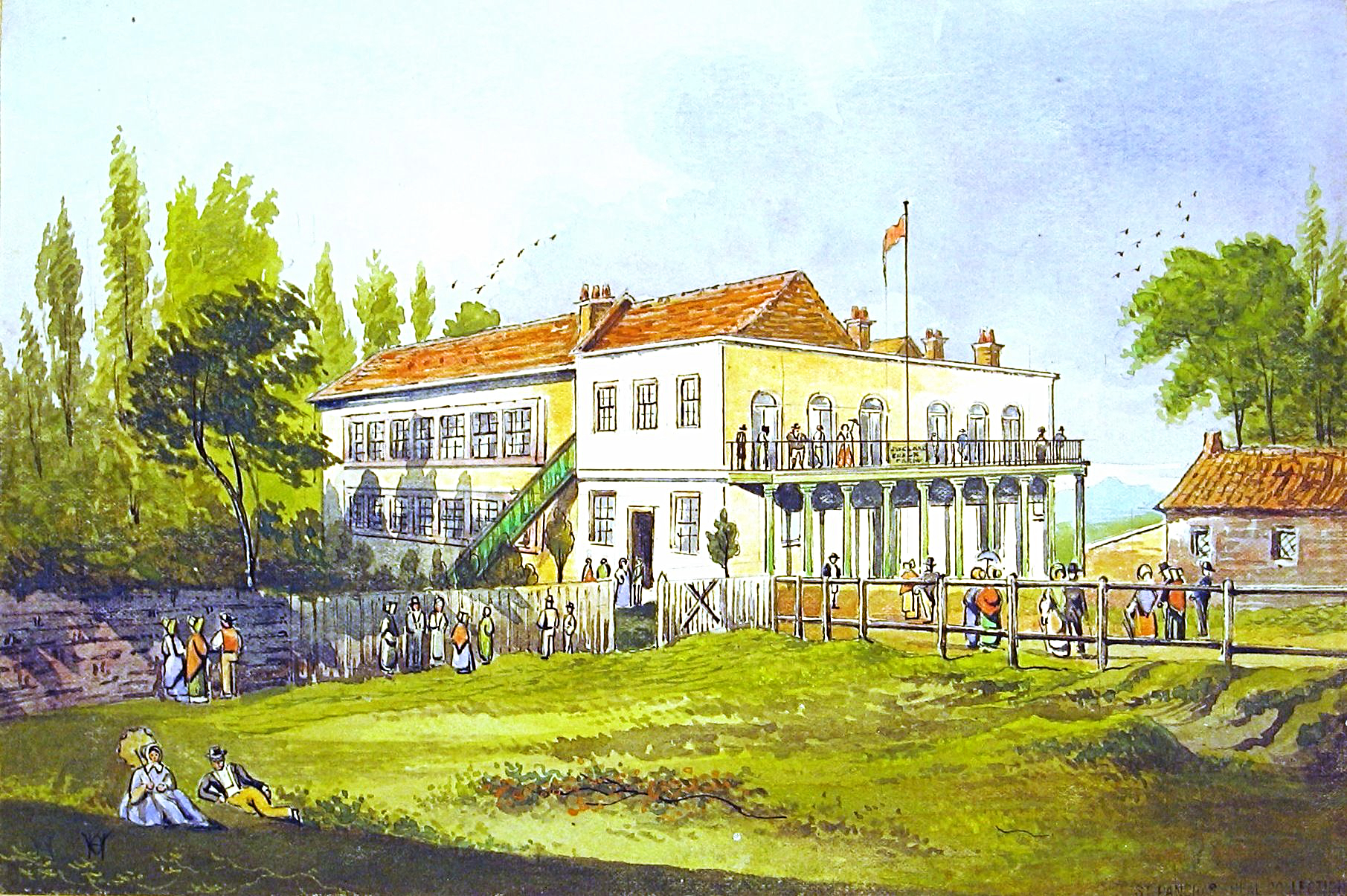
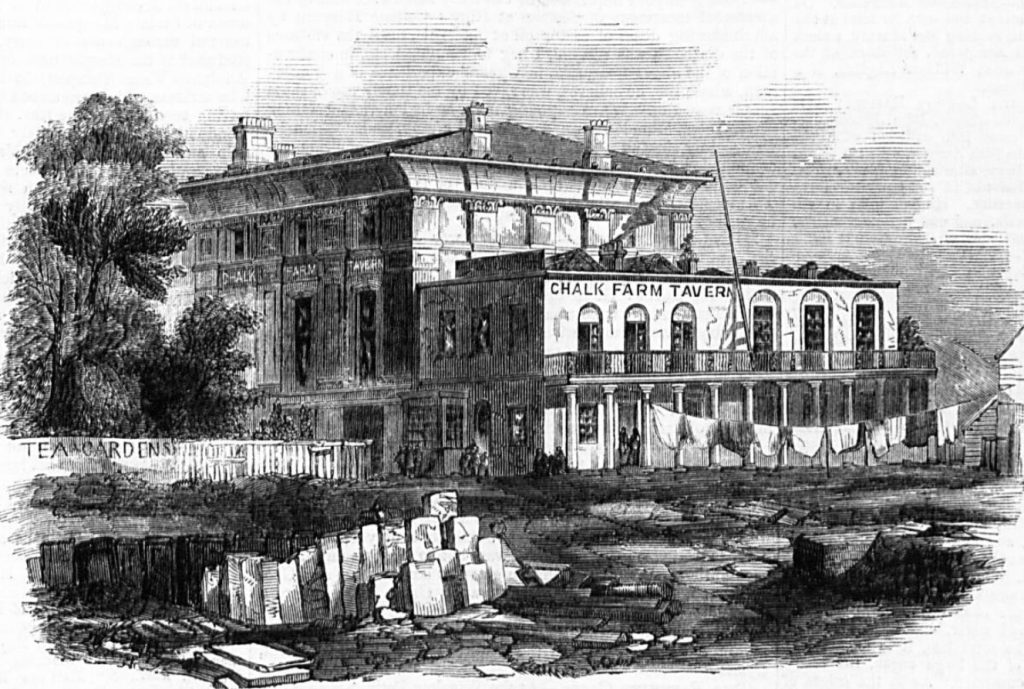
The Tavern was enlarged over 1847-48 and the balcony extended as seen in the painting (main image).

The licensee advertised in April 1848:
“… the Annual Sports will take place as usual on Easter Monday, Tuesday and Wednesday. The Gardens, which have been much improved, will be brilliantly illuminated. A splendid Band will be in attendance each day on the green. Admission free. The ball-room, capable of holding 800 persons, will be opened at Five o’clock. Gyoury’s Quadrille Band is engaged. To conclude each evening with a grand display of Fireworks.”
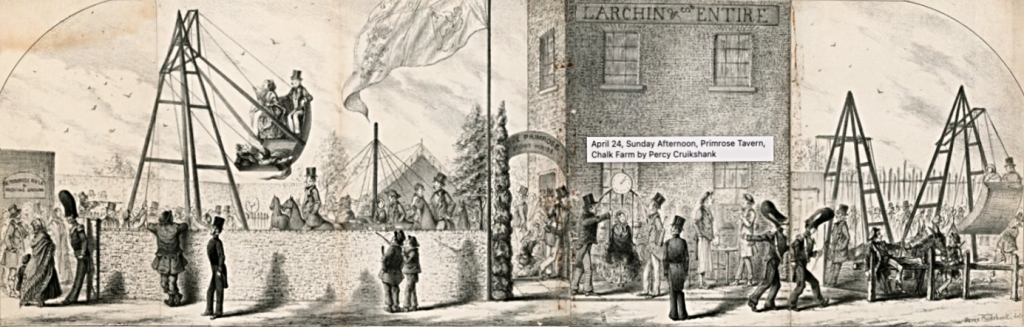
Competition for the Chalk Farm Tavern arrived briefly in the late 1840s in the form of the Primrose Tavern, a close neighbour on Regent’s Park Road, seen here around 1850 with the various unsophisticated entertainments it later added. It appears to have closed in 1851, after its owner went bankrupt.
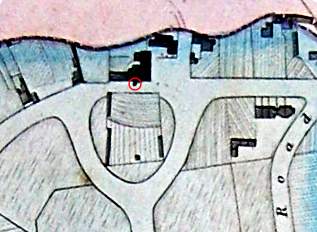
The area around Chalk Farm Tavern developed slowly on the lines of the Southampton estate auction sales plan. Such residential development, intended for the prosperous middle classes, created a number of conflicts with the licensees of the Tavern. There were complaints in 1851 of the stairs from the Long Room, which projected straight out from the side of the building, creating a hazard in the new Regent’s Park Road. There were further complaints by new residents of fairs in the neighbourhood of Chalk Farm Tavern, notably that the Chalk Farm Fair drew to the spot a number of disorderly and undesirable characters.
The stairs, shown circled in the plan, were removed, which must have had some influence on the decision to rebuild the Tavern without the Long Room. Much of the old building was demolished in 1853 to be replaced in 1854 by the new building with which we are now familiar. Bricks and other materials were auctioned in 1853 and would have been incorporated into houses built locally in the mid-1850s.
Several other public houses were built nearby in the mid-1850s, including the Queens, the Adelaide, the Pembroke Castle and the Lansdowne. Increasing competition led the Tavern to obtain a licence as a music hall from 1850 to 1862, formally under the name of the ‘Hare and Hounds’. The Chalk Farm Tavern remained popular primarily because its gardens were largely retained by the new building. These pleasure gardens, on the site now bounded by Berkley Road, Chalcot Square and Sharpleshall Street, were available for outdoor recreation and public entertainments. They were enclosed by lofty walls and decorated with ornamental trees and flowering shrubs.
David Stevenson, by now a senior employee in the Goods Department of the London and North Western Railway (LNWR), resided in Montrose House in Regent’s Park Road, a stone’s throw from Chalk Farm Tavern. He observed in October 1853 that:
“The ball-room at Chalk Farm Tavern is no more. It has been taken down to make way for some new houses. And so farewell thou scene of gents and dirty muslin! At one time, I suppose, greater swells frequented the place – white kids, cravats, and well-cut coats, and fair forms charmingly arrayed; but they all went their way, and of late years ‘sixpenny hops’ have made night hideous there − soldiers and servant maids, dirty drabs, and dangerous young fellers’ in curious clothing, with short pipes and wonderfully unclean hands, − such a set! And they, too, are all gone!”
Montrose House was located at the corner where The Chesterfields, a residential block converted from the former boys’ home, now stands. Stevenson sold his property for £1,300 (about £180,000 today) in 1856 to his employer, LNWR, to afford a right of way to Eton’s Chalcots Estate. This was the start of King Henry’s Road.
The new tavern building, completed in 1854 for Calvert & Co., was designed by Edward Blakeway l’Anson, son of an eminent architect, Edward l’Anson, who was later president of the Royal Institute of British Architects. As can be seen in the drawing, the architect retained substantial parts of the old building but added a floor to the main southern frontage on Regent’s Park Road. The adjoining building, seen on the east side in the drawing, formerly dining rooms with a large balcony, appears diminished and rendered out of scale by the new building, but was balanced by a similar building frontage to Regent’s Park Road on the west side.
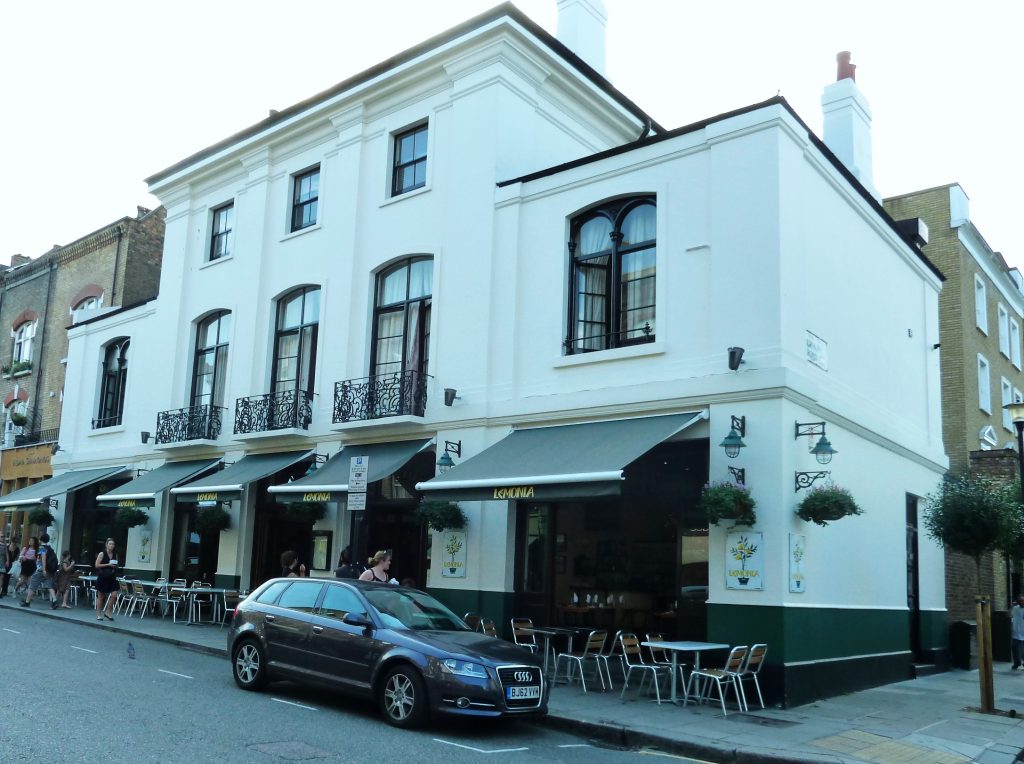
Now, 170 years later, we are able to appreciate the building he created which we know as Lemonia, the Greek Cypriot restaurant on Regent’s Park Road. Over time the east side has adapted to the development of Erskine Road, with part of the original retained.
We should further appreciate the strong continuity between the existing building and its forebears, in contrast to the common assumption that the 1854 building was a complete rebuild. The existing building remains remarkably true to the rebuilding of 1854.
While the former Long Room had been demolished, the new Tavern was nevertheless able to boast a dance floor capable of taking one thousand people as well as a bandstand known as the Chinese Orchestra, the large ballroom being decked with chandeliers and convex mirrors. This was situated in the former Tea Gardens from the mid-1850s until the Tavern’s music hall licence expired in 1862. For example, on 26 May 1860 the Tavern advertised its grand Whitsuntide galas:
“The public are informed that these delightful and popular Gardens will open for the season on Whit Sunday and Monday, and during the summer for a succession of Galas and Fetes on a scale of splendour never before attempted.
“The beautiful decorated Chinese Orchestra is 36 feet high, and tastefully illuminated with profusions of variegated Lamps, Chinese Lanterns, &c., together with a Leviathon Platform, capable of accommodating 1000 persons. Musical Director, Mons. V. Laurent, and the Quadrille Band from the Argyle Rooms. Mons. Louis Leglere and Son and Professor Gelline the unrivalled Vaulters and Trampoline Performers on the Cord volant par de jour, and terrific leaps through daggers, pipes, drums of liquid fire, &c &c. A Race with Two Balloons. The Illuminations, and a superb display of Fireworks at 10 o’clock, by H. F. Davis. Admission, Sundays by Refreshment Ticket, other days Sixpence each.”
For a quiet and very respectable residential neighbourhood, some remarkable entertainments were given in these “Gardens”, as described by Gilbert Dalziel of Fellows Road in a letter to the Hampstead Advertiser of 13 December 1923, having observed them some sixty years earlier from what is now No. 1 Chalcot Square:
“As a boy, I well remember seeing, from my Uncle’s drawing-room window at No 1 St George’s-square, Blondin, the hero of Niagara, walking the tight rope there. It was an evening performance, and Blondin garbed in shimmering silver was seen, balancing-pole in hand, crossing the rope at a very great height amidst a tremendous display of fireworks, finishing up by pushing a man seated in a wheelbarrow across the rope.
“It was a very curious spot in those days. In the fields on either side and at the back of the Tavern quite important Circuses would pitch their tents, now and again, with the usual supply of elephants, camels, performing horses, etc. On one occasion there was given a very lively boxing bout, between Tom Sayers, England’s idol for many years, and the American pugilist Heenan: but perhaps the most startling item in the programme, amidst Fat Ladies from Peru, and Spotted Boys from the Sahara, was a man, be-feathered and face-painted to represent a Wild-Indian, who killed live rats with his teeth!”
By the mid-1860s, however, Calverts the brewers, following complaints from the owners of nearby and recently-built houses, had sold off the garden for building plots and the Chalk Farm Tavern became just one of the many pubs in the area.