Chancellor Rachel Reeves announced in the October budget that the government – in spite of the 22 billion black hole – will find the funds for HS2 tunnelling between Old Oak Common and Euston.
What does this mean for Primrose Hill? Martin Sheppard convened a meeting in the Primrose Hill Community Centre and invited Lord Tony Berkeley, Paul Braithwaite and Jeff Travers in order to discuss the “monster lurking next to Primrose Hill for more than 10 years”.
Tony Berkeley, a Labour peer and civil engineer, told the audience, “No one has a bloody clue what’s happening next.” Currently there are 2,000-tonne tunnel-boring machines in Old Oak Common waiting for the government to give the green light to dig the 4.7 miles underground to Camden. Lord Berkeley, who spent 15 years building the Channel Tunnel, said, “The idea of starting to build a tunnel, if you didn’t know where it’s going to come out, is a novel one.” His advice was to “Watch and wait. Lobby like hell if you feel like it. Talk about the money.”
Former Lib Dem councillor Paul Braithwaite compared HS2 to the Monty Python sketch in which Michael Palin has limb after limb cut off in a duel, in that various legs of HS2 have been chopped off, including extensions to Heathrow, Leeds, Manchester and Warrington. In October 2023, Rishi Sunak decreed that funding for both Euston and the tunnelling from Old Oak Common – if the leg was to proceed at all – would be paid for by private investment. He specified that the HS2 Euston station design should be reduced from 11 platforms to just six – reflecting the cancellation of the routes to both Leeds and Manchester. This removed £6.5bn from the public purse commitment, which was then re-allocated to infrastructure schemes across the country. The HS2 phase 1 costing was last estimated to be a total of £76bn at 2019 prices, excluding Euston and the tunnels from Old Oak Common.

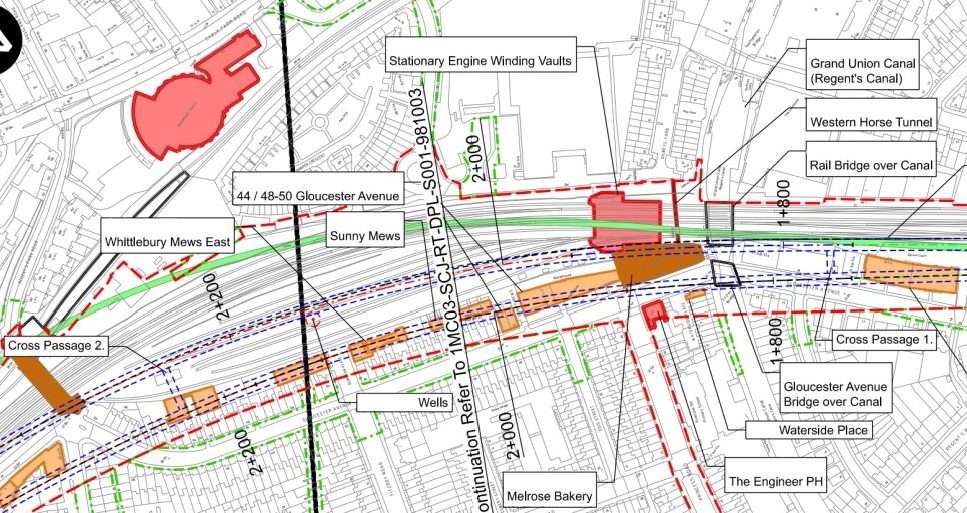
Jeff Travers is a local architect who told the meeting that part of his back garden had been subjected to a compulsory purchase order as he lives so close to the proposed line. Jeff has managed to get hold of the latest plans from SCS, the engineers with the contract to design and build the tunnels. As can be seen on the plans, HS2’s nearer tunnel will run beneath Foxton’s, under most of Darwin Court and the electricity substation at 36 Gloucester Avenue, before crossing under Fitzroy Bridge to near the corner of Waterside Place. It will then go under 42-50 Gloucester Avenue, Sunny Mews, Whittlebury Mews East and West, 110 Gloucester Avenue, and 134 and 136 Gloucester Avenue before crossing under the road. The tunnel continues under 196 Regent’s Park Road and the Chesterfields, then 1 and 6 King Henry’s Road, before crossing railway land to the Adelaide Road vent shaft. HS2’s other (eastern) tunnel will only affect the back of No. 42 Gloucester Avenue and the beer garden of the Pembroke Castle. The depth at which the tunnel will be dug will be 28 metres at the beginning of Darwin Court, 29.4 metres at Dumpton Place and 36.38 metres at the Chesterfields. These measurements are all to the bottom of the tunnel, which will be 7.3 metres in diameter.
The main impact to date has been road closures. One of the houses in Adelaide Road has been badly impacted by the vent shaft, which has also destroyed a considerable area of green corridor. Most of the enabling works in the area, however, have now been completed. HS2’s lorry depot, between Prince Albert Road and Gloucester Gate, has been largely unused but, if the extension to Euston goes ahead, may see increased haulage for years. In the process of its construction, one of the last strongholds of the hedgehog in central London was destroyed.
What will be the effect of the nearer (western) tunnel, if it is dug? The tunnel-boring machines are capable of boring through clay at a remarkable rate, lining the bore with concrete segments and grouting as they go, leaving a stable tunnel behind them. The walls of the tunnel are only liable to deterioration while the clay dries. However, much of the Camden Railway Yard had spoil from the Chalk Farm Tunnel and railway cuttings spread upon it in the 1830s, which may cause instability. Secondly, there may be ‘boggy pockets’ along the course of the tunnelling. There is an additional settlement risk from the cross passages. One of these is under the electricity substation next to the north-western end of Darwin Court; the other is behind 136 Gloucester Avenue. These will be dug not by the tunnel-boring machines but by robots.
The digging of the tunnels themselves will probably be imperceptible on the surface. With modern systems of insulation, it is also unlikely that HS2’s trains, which at this point will not be travelling fast, will be heard. The noise of trains on the surface, and indeed of cars in Gloucester Avenue, is likely to remain much greater.
Many of the buildings under which HS2’s nearer tunnel passes, including Darwin Court, Sunny Mews and Whittlebury Mews East and West, are modern constructions and have foundations able to withstand minor settlement. This should of course be checked. The early housing in Gloucester Avenue, by contrast, was built without foundations. Many of the houses have experienced a lesser or greater degree of settlement over the years. Although HS2’s tunnelling may cause a small degree of extra settlement, this is likely to be minor. The special cases of 44 Gloucester Avenue, 196 Regent’s Park Road, the Chesterfields and 1 and 6 King Henry’s Road, under which the tunnel will go directly, need individual monitoring.
HS2 (or its contractor) have a legal duty to survey properties. For Primrose Hill, HS2 may be inclined to generalise, notably regarding terraced property, without checking whether structural modifications have been made, such as rear extensions which may be prone to differential settlement.
Surveys have already been completed at Park Village East, where settlement is predicted to be excessive and damaging. HS2 is currently carrying out preparatory mitigation (underpinning), causing great disruption.
The necessity for property-owners to take precautions depends on whether HS2 goes ahead with its tunnelling. Even if the tunnels are excavated as far as Parkway, because HS2’s contract with SCS cannot be cancelled, there is no guarantee that they will actually reach Euston. The engineering challenges, and associated risks, of designing the enormous ‘Burrow’ in the throat of the Euston cutting have not to date been resolved to the point where the proposals can be signed off officially.
To these problems must be added the relatively small space available to developers on the west side of Euston. They are most unlikely to be willing to finance the tunnels, despite the government’s hopes. Finally, none of the plans currently on offer address the glaring failure to replace the pitifully outdated existing Euston Station.
Property owners have a number of rights and other potential guarantees at their disposal. They can also take precautionary measures if it looks as if the tunnels are about to be bored. Two elements which may have their performance affected are doors and drains. As most of the doors in the affected properties are likely to be in flats, they may be fire doors which need to meet strict tolerances. A careful record of the current state of these should be considered. We plan to provide a detailed guide to what property-owners can and should do if they consider themselves at danger from HS2’s tunnelling. This will be available on the Primrose Hill Community Association website.
Thanks to Martin Sheppard and Jeff Travers for supplying the information for this article.