By Ylwa Warghusen
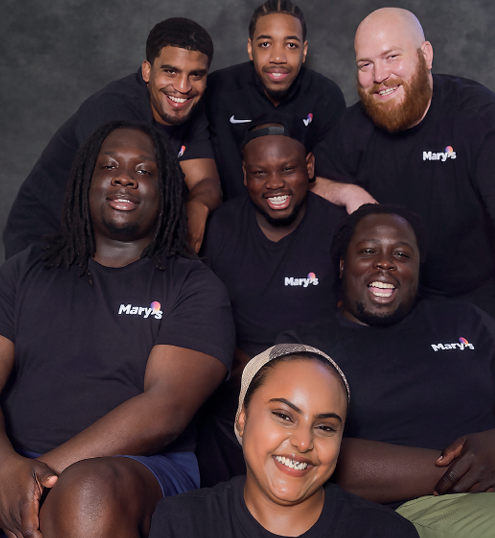
Photograph by Sarah Louise Ramsay
This is the third time that Jason Allen has graced the cover of On The Hill – a record! Jason founded Mary’s Charity in 2005, and readers may know about the important work they do to prevent youth violence. This includes gang mediation, safeguarding, prison work and maintaining knife bins, where anyone can safely and anonymously dispose of weapons; one of these is located just outside the charity’s office in Primrose Hill.

When I ask what’s new about Mary’s Charity, Jason proudly shows me images from the charity’s Instagram account, @maryscharityyouthwork. “Because we’re so good at mediating violent situations, people sometimes don’t see the other part of what we do – the youth work.” In fact, as much as 80% of the charity’s activity is focused on these youth programmes, with the remaining 20% dedicated to crisis response, conflict mediation and serious youth violence interventions.
The youth work is extremely varied and includes everything from candle making, baking and cooking clubs to football and art therapy. The charity runs homework clubs and helps with college and UCAS applications, as well as preparing young people to find employment. They also organise residential trips, where the youngsters learn real-life skills such as budgeting when shopping for groceries. All this youth provision primarily supports young people aged 11–18, alongside specific 18+ provision.
Mary’s also holds the distinction of being a recognised educational centre – they facilitate training for students to achieve the Level 1 and Level 2 National Accredited Certificate. In 2025, 482 young people successfully gained these qualifications through Mary’s. This preventative work aims to stop young people falling into violence by providing guidance and alternative activities – helping them see that they have a choice in how they lead their lives. “It takes a community to save a community,” as Jason puts it.
I ask him to describe a typical day. “Every day is different but, as an illustration, on any given day, members of our team could be running groups at three local secondary schools, providing mentoring (available 24/7), facilitating a sports workshop for kids not currently in education, mediating serious conflicts and tensions between young people or guiding an educational trip to London Zoo. Then there are statutory meetings with local authorities, social services, the police, plus a lot of paperwork.”
The team consists of around 25 people in total, with a core team of 10. They often take a therapeutic approach, and many in the team have psychotherapy training. The goal is to equip youngsters with the emotional skills to make sound choices and form healthy relationships. A case in point comes from research conducted by Mary’s Charity in conjunction with Middlesex University, in which Mary’s staff interviewed over 200 young people. This revealed some striking findings: 83% said that “being excluded from school meant they couldn’t build positive relationships with other people”; and 84% said that “being excluded from school exposed them to criminal activity which their friends in school did not experience”. School exclusion is clearly a tipping point for many young people.
I ask if there are plans to expand the charity. “We’ve had multiple opportunities to grow in other areas, but Primrose Hill is our home. It’s quality over quantity.” Even just one life saved is worth everything. In 2025, just over 2,000 youths were supported by Mary’s, around 80% boys and 20% girls. “If we had more resources we could definitely help more kids. We’re inundated with referrals – from schools, social services, parents.” More resources would also enable the charity to provide one-to-one sessions in schools in addition to the group sessions it currently runs.
I ask Jason to give me an example of a success story. “We can’t talk about many of the success stories for safeguarding reasons, but there are numerous examples of kids who have turned their lives around.” One that they can mention is that of Abdisamed. He grew up in an environment with entrenched gang violence and lost three family members to youth violence. He was close to going down this path when Mary’s started working with him and supported him through school, UCAS applications, a bachelor’s degree and on to a master’s degree in Law where he attained the top grade. Now in his early 20s, Abdisamed is a trainee solicitor at PwC, yet he still finds time to give back to the community by overseeing part of Mary’s employment section. “When we can work in-depth with people, we can guide them to fulfil their potential, to what their life can be.”
Still, Jason says, “we can’t eradicate violence. Conflict exists across society, but people resolve it differently. In business, you might write to your lawyer; for vulnerable young people without those tools, conflict can lead to violence or carrying a weapon. Our work helps young people to develop safer ways to manage conflict. For some, carrying a knife has become normalised as self-defence, but carrying a weapon can actually increase the risk of harm.”
I ask why young people join gangs. “There are a variety of factors – lack of confidence, lack of choice and opportunities.” The gangs we’re talking about here are mainly the small, local gangs as opposed to larger organised crime groups (OCGs). The former are essentially friendship groups who grew up in the same area, sharing similar experiences of trauma and lack of opportunities. Criminality is a by-product. “They fall into what they see around them, the familiar. Not everyone can make a better choice, it’s not really available to them; but if you work with young people and enable them, the overwhelming majority will flourish.” When supported by Mary’s, these kids realise they have a choice.
Things are improving around knife-enabled crime, with the Metropolitan Police reporting a London-wide drop of 17% from 2024 to 2026. Furthermore, in England and Wales the Office for National Statistics recorded a 21% drop in killings using a knife or sharp weapon last year. Still, Mary’s has lost four young people to knife crime this year. This is extremely tough for the team.
My final question is simple: what can readers do to help? “Reach out. There’s always a need for funding, but also for different skill sets. There are openings on the committee. And providing job opportunities or work experience for young people would be hugely valuable.”
We are lucky enough to live in a leafy, privileged enclave of the capital, yet a few streets away many are struggling in very different circumstances. The work of Mary’s Charity is noble, tremendously important and deserving of all our support.