
By Ylwa Warghusen.
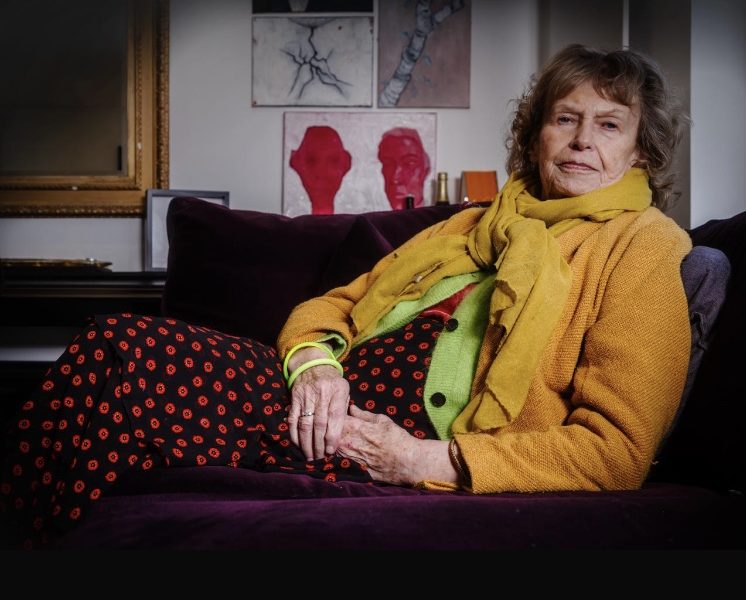
Photograph by Sarah Louise Ramsay.
On a grey Monday in October, I’m on my way to meet Lauren Child at her studio − ‘a room of her own’ − tucked just down the road from her home in Primrose Hill. It’s a well-organised space with shelves up to the ceiling, brimming with books, art materials, paintings and ideas.

Much has already been written about the award-winning author/illustrator and former Children’s Laureate, creator of colourful characters: Charlie and Lola, Clarice Bean and Ruby Redfort amongst others. She is also known for having pioneered an innovative illustration style: a collage of drawing, paper cutouts, fabric design, photo montage and imaginative typeset.
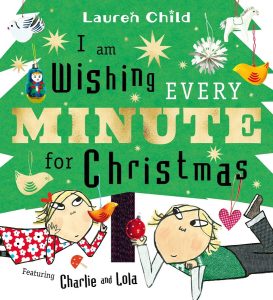
Child is friendly and immediately relatable, elegant in a fitted black ensemble. We’re here partly to talk about the new Charlie and Lola book, I am Wishing Every Minute for Christmas, released 25 years after the world first met the eponymous siblings.
The book is actually more about the lead-up to Christmas, rather than Christmas itself. “It’s about managing the anticipation of Christmas, which is really hard for a small child, not to mention the parents,” the author, a parent herself, comments. In the book, Lola’s resourceful older brother Charlie comes up with ways to make the wait more fun for her. This process takes them from stomping through leaves in September, making arts and crafts in October and November, an actionable Advent Calendar in December, culminating in Christmas. It’s a book that celebrates creativity.
Child sees the siblings as Danish, living in Copenhagen. She spent time in Denmark and has an affinity for Scandinavia. One character who has become rather famous, even lending his name to an indie band, is Soren Lorensen, Lola’s imaginary friend. The character is based on Child’s Danish friend Sofie’s ‘real life’ imaginary friend. Another influence is Carl Larsson, the Swedish painter (1853−1919). “He paints the details, the specifics. He creates an atmosphere − often of family life and interiors.” Child has always been interested in interior design, which can be seen in her use of wallpaper and prints in her illustration. She has also designed fabric patterns for Liberty.
“The Charlie and Lola series looks at the world through the eyes of a child. I hope that reading these books will inspire conversations between adults and children and also between children.” The dialogue feels totally genuine. “I really listen to things children say; it’s about paying attention.” Child feels that candour is important in how we interact with children: “Children are often so much more aware of things than we’d like to believe. In my work as a writer for children, it’s important to be honest, but also to reassure and leave them with a sense of optimism. You have to tell the truth, but in a considerate way.”
Of all her characters, Clarice Bean is the one closest to Child; they have a similar viewpoint. She is also the most relatable character, as you could imagine meeting her in real life. The reality of Clarice’s family life is quite ordinary, but of course this includes events that are of momentous importance to her, like when she meets the author of her favourite book series, Ruby Redfort. The family lives in a multigenerational house, the father having quite an ordinary job − although in Clarice’s eyes he’s a star.
Child now lives in North London and a lot of the places in the books are based on real places in Kentish Town and Primrose Hill, such as the now-closed health food shop, Sesame, once run by Peter Haxton (Waldo Park in the books) and Primrose Corner. A Primrose Hill resident for many years, Child appreciates the area’s community village feel. Some local favourites are Primrose Hill Books and Sam’s Café, which being slightly off the beaten track mean that it feels like a dedicated space for residents. But her absolute favourite is the Hill itself: “It’s a place where you can just be. There’s something special about being high up, surrounded by the park, looking down over the houses, the skyline of London and so many trees.”
I ask about Child’s work routine. “I don’t have one!” A self-confessed procrastinator and daydreamer, who has still managed awe-inspiring productivity, she says her principal motivation is the fear of a looming deadline. She feels that writing is quite selfish: “I am locked in my head, spending a lot of time on what appears to be staring out of the window; but without that thinking space, I couldn’t do it.”
The characters come first, then the story. “I start with what interests me; I write a scene and go from there, hoping that I will reach the edges, thread things together and find an ending.” She must really feel who the characters are, what they want and what they have to lose. “I have written adventure and fairytale, but I usually write stories about ordinary people and the extraordinary things that can happen in the everyday. This interests me more. The Charlie and Lola stories are about normal life, about the so-called little things that feel very big to a child.”
The illustration process is more convivial. She can have a conversation while drawing, like when her daughter Tuesday was little and sat with her while she worked. (Tuesday is quite well-known in the local community. Often people come up to Child and ask, “Are you Tuesday’s mum?”)
Looking forward, there is a new project in the pipeline for 2026, Lotta and Lola. Lotta first appeared in I Am Too Absolutely Small for School and is Lola’s best friend. Child wanted to show just how daunting an ordinary event like starting at nursery can be for a child. The book is about the excuses Lola has for why she doesn’t in fact need to go to school. “I’ve always enjoyed listening to very little children talking back and forth, the way they navigate differences, and their extraordinary ability to travel in their imagination.
Child is a passionate advocate for the power of story-telling itself, rather than as a means to literacy. For her, children’s stories are about how we begin to understand each other, and the world. One joy of bedtime stories is that they are rarely read in a straight line, but are often interspersed with questions, explanations and diversions, sometimes about seemingly unrelated things. For Child, this all matters. As with any art form, it’s up to us what we take away.
Consistent with that theme, she is troubled by any tendency to label ourselves and others in a way that is limiting. “At a certain point, some children and adults are told, or tell themselves, ‘I’m not creative’, but the truth is that we’re all creative. Everyone has an imagination. We should be very slow to label anyone as lacking such a fundamental quality, especially children, as these labels can stick with them for a long time.” She rejects the idea that you have to be good at something to practise it: “It shouldn’t matter: if you love singing, just sing.” On her website, Staring into Space, Child talks about the importance of “just being”. Without the need to be productive, that blank, unscripted time allows us to discover our innate creativity.
As I say goodbye and venture outside, the leaden skies have opened and crimson leaves are twirling in the wind. Charlie and Lola would be delighted; it’s already starting to feel a little closer to Christmas.